CAPM Documentation Depth by Method
Study CAPM Documentation Depth by Method: key concepts, common traps, and exam decision cues.
Documentation depth changes with delivery method, but CAPM does not reward simple stereotypes such as predictive equals heavy and agile equals light. The stronger answer matches documentation to uncertainty, governance pressure, stakeholder risk, and the cost of misunderstanding.
Why Documentation Depth Changes
Predictive delivery usually benefits from earlier agreement on scope, sequence, interfaces, and approval points. That often leads to more detailed requirements packages, clearer baselines, and stronger trace links before execution moves too far. The goal is not paperwork for its own sake. The goal is to reduce ambiguity when change is expensive.
Adaptive delivery handles uncertainty differently. Teams expect learning during delivery, so detailed up-front specifications for everything are often wasteful. Instead, the stronger pattern is lighter early documentation paired with frequent clarification, backlog refinement, acceptance criteria, and rapid feedback.
Hybrid delivery sits between those poles. Some parts of the work may need stronger baseline discipline, while other parts remain intentionally flexible.
Baselining Versus Continuous Refinement
One of the most testable differences in this chapter is how requirements become stable enough to act on. In predictive work, the project often depends on a clearer baseline before downstream execution begins. That baseline may be approved formally because late change can disrupt cost, schedule, contracts, or dependent teams. In adaptive work, the team still needs clarity, but it usually gets that clarity through repeated refinement, iteration planning, examples, and delivery feedback rather than a single broad sign-off event.
The exam often hides this distinction inside scenario language. If the situation emphasizes formal approvals, stable interfaces, external commitments, or controlled downstream execution, stronger baseline discipline usually matters more. If the situation emphasizes learning, reprioritization, and evolving detail, continuous refinement is usually the stronger pattern.
What CAPM Usually Wants
CAPM usually rewards the response that asks what decisions the documentation must support. Strong documentation should:
- clarify the problem and intended value
- support planning and prioritization
- reduce rework from misunderstanding
- meet governance, audit, or compliance needs
- stay usable by the people who actually perform the work
The weaker response treats documentation as either automatically comprehensive or automatically minimal.
What Changes The Answer
The strongest answer usually depends on what is driving the need for detail:
- if teams need approval evidence, baseline comparison, or audit proof, predictive-style documentation usually gets stronger
- if teams need to learn quickly from delivery and refine work continuously, adaptive artifacts usually get stronger
- if one part of the work is regulated or contract-bound while another is exploratory, hybrid tailoring is usually strongest
- if the cost of misunderstanding is low and the cost of delay is high, over-documenting is usually weaker than clarifying just enough to support the next decision
Visual Guide
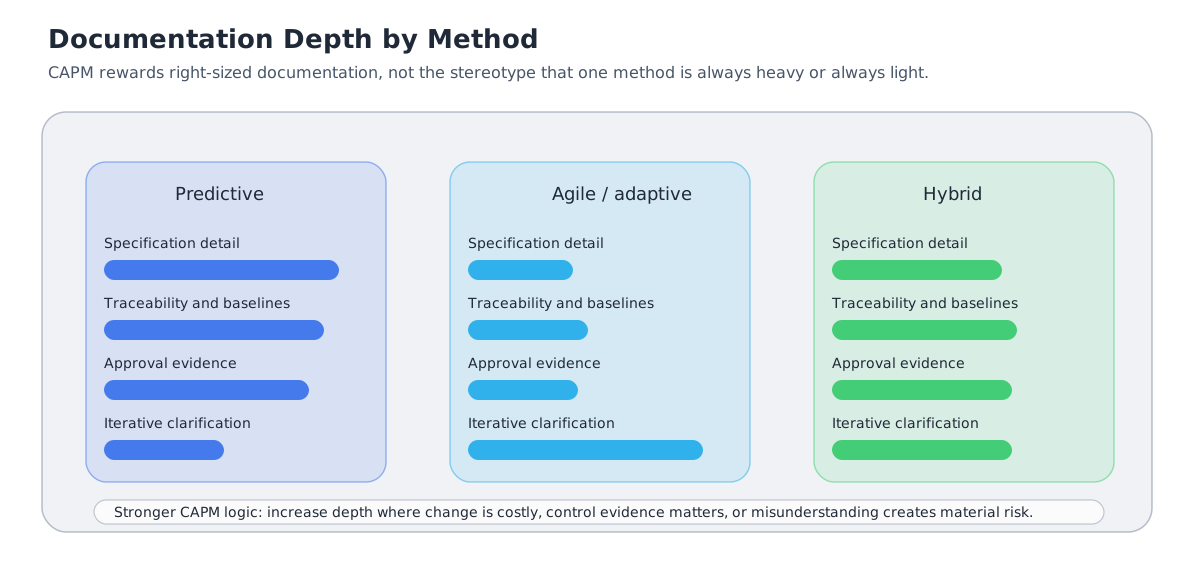
This comparison teaches the point faster than a decision flow because the real lesson is relative depth by method. CAPM usually wants you to compare how predictive, agile, and hybrid work distribute specification detail, traceability, and approval evidence rather than pretending one documentation style fits all work.
Predictive, Agile, And Hybrid Patterns
In predictive work, a requirements package may need formal sign-off, interface detail, acceptance thresholds, and a stable baseline. In agile work, the same business need may begin as epics, stories, acceptance criteria, examples, and lightweight process visuals. In hybrid work, external vendor interfaces or regulatory controls may need predictive-style precision while internal feature development stays backlog-driven.
That is why CAPM often favors selective depth. The stronger answer does not copy one method’s artifacts into every context.
Testability Still Matters In Every Method
The delivery method changes the expression of requirements, but it does not remove the need for testable requirements. A predictive requirement may be validated through detailed acceptance conditions, interface rules, and traceability to planned tests. An adaptive backlog item may use acceptance criteria, examples, and review feedback to reach the same outcome. CAPM often rewards the answer that protects verifiability regardless of format.
Example
A hospital project includes a regulatory reporting interface and a patient-facing portal. The reporting interface may need detailed data definitions, sign-off, and strong traceability. The portal experience may start with personas, stories, prototypes, and evolving acceptance criteria. A strong CAPM response recognizes that both styles can coexist in one project.
Common Pitfalls
- assuming agile means almost no documentation
- assuming predictive means documenting every possible detail whether useful or not
- forgetting that compliance or external integration may require more evidence even in hybrid or agile work
- choosing documentation style by habit instead of by risk and governance needs
Check Your Understanding
Sample Exam Question
Scenario: A team is delivering a customer mobile app using iterations, but one feature also exchanges regulated data with an external government system. The product owner wants only lightweight stories for all work, while the compliance lead wants formal interface definitions and approval evidence for the regulated exchange.
Question: Which documentation approach is strongest?
- A. Use one lightweight story template for all work so documentation stays consistent across the delivery model
- B. Require full predictive specifications and formal sign-off for every feature so the team does not have to manage mixed controls
- C. Use stronger interface definitions, traceability, and approval evidence for the regulated exchange while keeping lighter iterative documentation for app features that will evolve through feedback
- D. Remove the regulated exchange from project documentation and treat it as an operational issue instead
Best answer: C
Explanation: The strongest response right-sizes documentation to the work. The regulated exchange has higher governance and traceability needs, while the rest of the product can still use lighter iterative documentation where learning and change are expected.
Why the other options are weaker:
- A: One uniform lightweight approach ignores the stronger control needs of the regulated interface.
- B: Full predictive rigor for every feature over-controls the adaptive part of the product.
- D: Reclassifying the interface does not remove the need to document and govern it.