CAPM Release Planning and Iteration-Length Tradeoffs
Study CAPM Release Planning and Iteration-Length Tradeoffs: key concepts, common traps, and exam decision cues.
Release planning connects broader goals to likely groups of increments. Iteration cadence controls how quickly the team learns and how often it pays the planning and review overhead cost. CAPM often tests these together because both shape how adaptive delivery behaves over time.
Why Release Planning Exists
Adaptive teams still need a mid-range view. Roadmaps express broader direction. Iterations express short-cycle commitments. Release planning sits in between and helps stakeholders understand which increments are likely to support the next meaningful delivery point.
The strongest CAPM answer usually recognizes that release planning is forward-looking but still adaptive. It is not a frozen predictive baseline in disguise.
That distinction matters because weak answers often swing too far in one direction. One extreme tries to make adaptive release planning behave like a detailed predictive master schedule. The other extreme rejects medium-range planning altogether. CAPM usually rewards the balanced position: plan enough to guide value delivery, but stay ready to adjust as feedback changes priorities and assumptions.
Why Cadence Tradeoffs Matter
Shorter iterations create faster feedback and earlier correction opportunities, but they also increase planning and review frequency. Longer iterations can reduce ceremony overhead and allow larger slices of work to stabilize, but they delay learning and can let mistakes persist longer.
The right cadence depends on volatility, review availability, feedback need, and delivery complexity.
In exam scenarios, cadence questions usually hinge on fit rather than ideology. If requirements evolve rapidly, stakeholders need frequent inspection, and the team can support regular reviews, shorter iterations are often stronger. If work requires larger integration windows or stakeholders cannot review very often, a somewhat longer cadence may be more practical. The correct answer is usually the option that balances learning speed with operational reality.
Visual Guide
The diagram below shows the two CAPM ideas together: release planning sits between roadmap goals and short-cycle iteration planning, and cadence choice is a tradeoff between faster feedback and higher review overhead. That is easier to teach with comparative spacing than with a schematic flowchart.
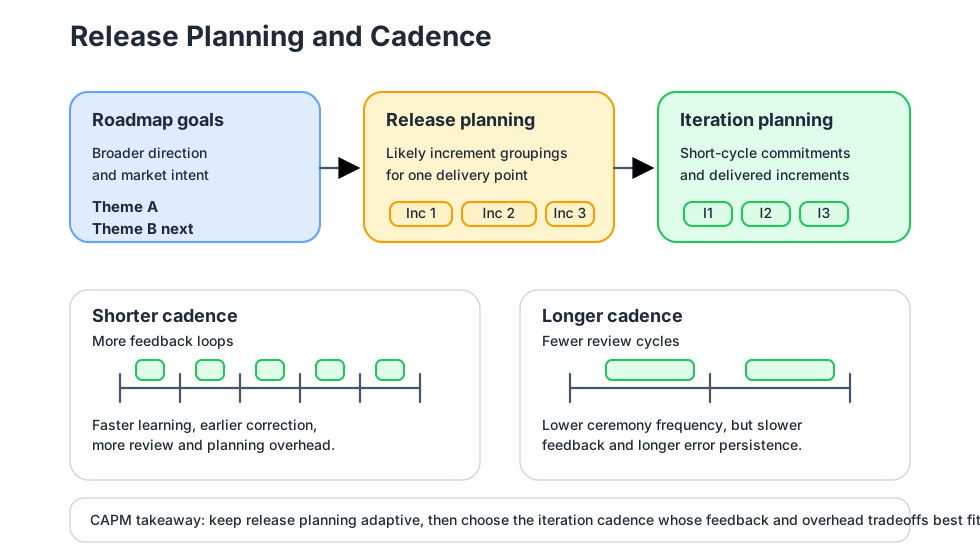
The main point to notice is that release planning does not replace iteration planning. It frames likely value delivery across multiple iterations. Iteration planning then makes the near-term commitment. Confusing those levels often leads to weak exam answers.
Release Planning Versus Iteration Planning
| Planning level | Main question | Time horizon | Typical mistake |
|---|---|---|---|
| Roadmap | Where is the product or project headed? | Broad direction | Treating direction as committed delivery detail |
| Release planning | Which increments are likely to support the next meaningful release? | Medium range | Treating the release plan as frozen certainty |
| Iteration planning | What should the team commit to next? | Near term | Ignoring goal, capacity, or new feedback |
CAPM often tests whether you can keep these levels distinct. If stakeholders want to understand the next release, removing all release planning is usually too weak. If they want certainty about every future iteration, pretending adaptive work can provide it is also too weak.
What Good Cadence Decisions Look Like
A good cadence choice usually reflects:
- how quickly feedback needs to shape direction
- how often stakeholders can realistically inspect progress
- how much coordination overhead the team can absorb
- whether work can be sliced into small, reviewable increments
If work is highly uncertain, shorter cycles usually help reduce risk through earlier learning. If every cycle requires costly setup, coordination, or approvals, a slightly longer cadence may be more sustainable. CAPM rewards tradeoff awareness rather than slogans such as “always shorten the sprint.”
Example
A team works in four-week iterations, but stakeholders complain that they wait too long to influence priorities. If the team can support more frequent reviews, shorter iterations may improve learning. At the same time, release planning can still show how the next few increments support a broader market release.
Now add another factor: the team is coordinating with a compliance group that can only review at fixed intervals. In that case, shortening cadence may still be useful for internal learning, but the team also has to consider whether external review constraints limit the practical benefit. This is the kind of context-sensitive judgment CAPM tends to reward.
Exam Scenario
Leadership asks for a detailed six-month release plan with exact feature dates because marketing wants certainty. The team explains that discovery work and stakeholder feedback are still likely to reshape priorities. Another manager proposes skipping release planning entirely to avoid making promises.
The strongest CAPM response is to keep a release plan, but treat it as a medium-range adaptive view that groups likely increments around release intent. Exact short-cycle commitments should stay inside iteration planning. This preserves direction without making false promises.
Common Pitfalls
- treating release planning as a fixed long-range certainty machine
- confusing release planning with immediate iteration planning
- saying shorter iterations are always better
- ignoring the overhead cost of more frequent planning and review
- dropping release planning entirely because adaptive work is uncertain
- changing cadence without checking whether the team and stakeholders can sustain the change
Check Your Understanding
Sample Exam Question
Scenario: Stakeholders want to know how the next several iterations are likely to support an upcoming release, but the team still expects priorities to evolve with feedback. At the same time, stakeholders complain that the current four-week cadence delays learning too much.
Question: What release-planning response fits this situation best?
- A. Freeze the release plan through the target release so stakeholders get certainty, and revisit cadence only after launch
- B. Use release planning to connect roadmap goals to likely increment groupings, and consider a shorter cadence if the team can support the extra review overhead
- C. Drop release planning altogether and rely on iteration planning only, because medium-range views usually create false promises
- D. Shorten the cadence immediately, even if the team has not assessed whether it can absorb the extra coordination and review load
Best answer: B
Explanation: CAPM usually rewards adaptive medium-range planning plus a context-based cadence decision, not rigid certainty or anti-planning dogma.
Why the other options are weaker:
- A: It makes adaptive planning too rigid.
- C: Adaptive delivery still benefits from broader planning horizons.
- D: Cadence should be chosen for fit, not changed automatically.