CAPM Key Plans, Logs, and Registers
Study CAPM Key Plans, Logs, and Registers: key concepts, common traps, and exam decision cues.
Planning artifacts are easier to learn when you connect each one to the coordination problem it solves. CAPM usually tests whether you can match the situation to the right artifact, not whether you can recite a long document inventory from memory.
The Basic Artifact Categories
Plans explain how the team intends to manage an area of the project. Registers store structured tracked information that changes over time. Logs often capture ongoing items, events, or actions that need monitoring and follow-through.
| Artifact | Typical purpose |
|---|---|
| Risk register | tracks identified risks, responses, owners, and status |
| Stakeholder register | tracks stakeholders and relevant analysis data |
| Issue log | tracks current problems requiring action |
| Assumption log | records assumptions and constraints that need visibility |
| Communications or risk management plan | explains how the area will be managed |
The exact artifact list varies by method and organization, but the exam logic stays consistent.
How To Match Artifact to Need
If the scenario is about uncertainty that may happen, think risk register. If the problem is happening now and needs management action, think issue log. If the team is documenting things believed to be true for planning, or limitations that shape the work, think assumption or constraint tracking.
This matters because weak answers often choose an artifact by vague familiarity instead of by function.
Visual Guide
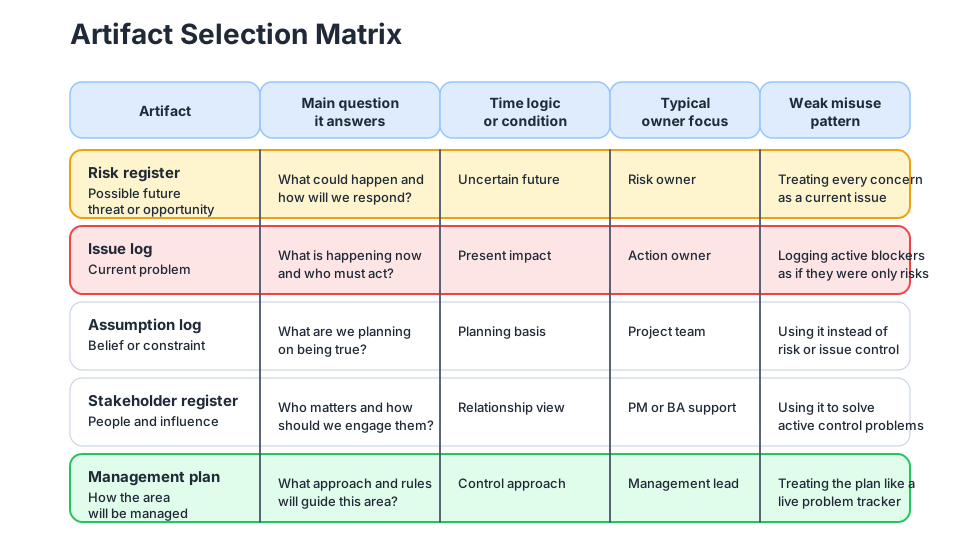
This matrix makes the artifact choice more concrete than a prose list. CAPM usually rewards matching the situation to the control question being asked: uncertain future impact points toward risk logic, a current blocker points toward issue logic, and a management approach points toward a plan rather than a live tracker.
Example
Suppose a vendor may miss a future delivery date because customs approval is uncertain. That is a risk. If the shipment is already late and work is blocked, it is now an issue. If the project planned under the belief that approval would take two days, that belief is an assumption worth tracking.
The words are related, but they do different jobs.
What Good Practice Looks Like
Good planning artifacts are:
- current enough to support decisions
- specific enough to guide action
- visible to the people who need them
An artifact that exists only to satisfy a template is weak, even if it has the correct title.
The Strongest Artifact Depends On The State Of The Problem
CAPM often tests whether you can see the difference between something that may happen, something happening now, and something believed to be true for planning. Those are different states, and they usually belong in different artifacts. The strongest choice often comes from asking:
- is this uncertain future exposure
- is this a current blocker or problem
- is this a planning belief or limitation shaping the work
That simple decision path helps separate risks, issues, assumptions, and constraints under pressure.
Plans Guide The Area; Registers And Logs Track The Live Items
Another useful distinction is that a plan usually explains how an area will be managed, while a register or log tracks the actual items inside that area over time. CAPM questions often reward candidates who notice this difference. A risk management plan explains how risk work will be approached. A risk register stores identified risks, responses, owners, and status. Similar logic applies in other areas.
This means a good answer often pairs the two concepts correctly instead of treating them as interchangeable.
Artifact Choice Should Support Action
The best artifact is not just the one with the right label. It is the one that helps the team act. If the problem is current, the team needs ownership and follow-through now. If the concern is uncertain, the team needs structured monitoring and response planning. If the item is shaping planning assumptions, the team needs visibility into what may later prove false.
That action orientation is usually what CAPM is really testing.
Check Your Understanding
Sample Exam Question
Scenario: A project team learns that a third-party permit may be delayed because the regulator is reviewing additional documentation. Work is not yet blocked, but the uncertainty could affect the schedule if the permit is not approved in time.
Question: Which artifact is strongest for documenting the situation first?
- A. Issue log, because any threat to the schedule should be treated as a current problem immediately
- B. Risk register, because the permit delay is still uncertain and may affect future work if it materializes
- C. Assumption log, because the team assumed the regulator would respond on time
- D. Stakeholder register, because the regulator is the external party creating the concern
Best answer: B
Explanation: The situation is still uncertain and may affect the project in the future, which makes the risk register the strongest first artifact.
Why the other options are weaker:
- A: If the permit is actually delayed and blocking work, it can move into issue handling later.
- C: Assumptions may matter, but the immediate control need is to manage uncertain impact, which is risk logic.
- D: The regulator may appear in stakeholder analysis, but that does not address the uncertainty itself.