CAPM Variance, Earned Value, and Forecasts
Study CAPM Variance, Earned Value, and Forecasts: key concepts, common traps, and exam decision cues.
Earned value and forecasting are useful on CAPM only when you can read them as management signals. The exam usually is not asking you to perform finance theater. It wants you to notice whether the project is spending efficiently, progressing as planned, and likely to finish near or far from its original target if current performance continues.
Start With Meaning, Not Formula Panic
Variance tells you whether current performance is favorable or unfavorable compared with the baseline. Earned value combines cost and schedule performance into one control picture. Forecasting then asks the forward-looking question: if the current pattern continues, where will the project probably finish?
That means the strongest reading sequence is usually:
- understand what has been planned
- compare earned value with actual cost and planned value
- interpret cost and schedule patterns together
- decide whether a forecast or corrective response is needed
CAPM often punishes formula memorization without interpretation. A candidate may calculate the right number and still choose the wrong answer if they do not understand what the number means.
Core Signals To Know
CV: cost varianceSV: schedule varianceCPI: cost performance indexSPI: schedule performance indexEAC: estimate at completionETC: estimate to completeVAC: variance at completion
Metric Snapshot
| Metric | Formula | Strong reading |
|---|---|---|
CV |
(EV - AC) | Negative means the project has spent more than the value earned. |
SV |
(EV - PV) | Negative means the project has earned less value than planned by this point. |
CPI |
(\frac{EV}{AC}) | Below 1.0 usually means cost efficiency is weak. |
SPI |
(\frac{EV}{PV}) | Below 1.0 usually means schedule efficiency is weak. |
EAC |
(\frac{BAC}{CPI}) when current cost performance is expected to continue | Forecasted total cost at finish under that assumption. |
ETC |
(EAC - AC) | Remaining expected spend from now to completion. |
VAC |
(BAC - EAC) | Forecasted difference between original total budget and expected finish cost. |
Formula Guide
[ CV = EV - AC ]
[ SV = EV - PV ]
[ CPI = \frac{EV}{AC} ]
[ SPI = \frac{EV}{PV} ]
[ EAC = \frac{BAC}{CPI} ]
[ ETC = EAC - AC ]
[ VAC = BAC - EAC ]
Where:
- (EV) = earned value
- (PV) = planned value
- (AC) = actual cost
- (BAC) = budget at completion
- (EAC) = estimate at completion
- (ETC) = estimate to complete
- (VAC) = variance at completion
The CPI-based form of EAC is useful when the question explicitly or implicitly assumes current cost efficiency will continue.
Reading PV, EV, And AC Together
The exam often presents the three basic values first:
- PV tells you how much value should have been earned by now according to the plan
- EV tells you how much value has actually been earned
- AC tells you what has actually been spent
From there:
- if (EV < PV), schedule performance is weak
- if (EV < AC), cost performance is weak
- if both are true, the project is underperforming on both dimensions
That is why CAPM often expects pattern reading, not isolated formula reading.
Pattern Interpretation
| Pattern | CAPM-style interpretation |
|---|---|
CV < 0 and SV < 0 |
Over budget and behind schedule together |
CPI < 1.0 and SPI < 1.0 |
Weak efficiency on both cost and schedule |
CV < 0 but SV > 0 |
Cost pressure with a mixed schedule picture |
CV > 0 but SV < 0 |
Cost looks better than plan, but schedule pressure remains |
EAC > BAC |
Current assumptions suggest finishing above the original budget |
VAC < 0 |
Forecast indicates an overrun against original budget |
CAPM may give you mixed signals on purpose. The strong answer notices the mixed picture rather than simplifying everything into “good” or “bad.”
What Forecasts Add
A variance describes current status. A forecast estimates where the project is likely to end if current conditions continue. That forward look matters because leadership often needs to know not just whether the project is weak now, but whether the current pattern threatens the final target.
Forecasting therefore turns control data into planning input:
EACestimates total finish costETCestimates remaining required spendVACestimates whether the project is likely to finish above or below the original budget
These are still estimates, not guarantees. CAPM sometimes tests that distinction directly.
Worked Example
Assume:
- (PV = 120)
- (EV = 105)
- (AC = 125)
- (BAC = 400)
Then:
[ CV = 105 - 125 = -20 ]
[ SV = 105 - 120 = -15 ]
[ CPI = \frac{105}{125} = 0.84 ]
[ SPI = \frac{105}{120} = 0.875 ]
Using the simple CPI-based forecast:
[ EAC = \frac{400}{0.84} \approx 476.19 ]
[ ETC = 476.19 - 125 \approx 351.19 ]
[ VAC = 400 - 476.19 \approx -76.19 ]
Interpretation:
- the project is over budget now
- the project is behind schedule now
- current cost efficiency is weak
- if current cost performance continues, the project is likely to finish above the original budget
CAPM usually wants that interpretation more than the arithmetic itself.
Visual Guide
This chart shows a pattern CAPM often tests: planned value sits above earned value, and actual cost sits above earned value. That means schedule pressure and cost pressure are both present.
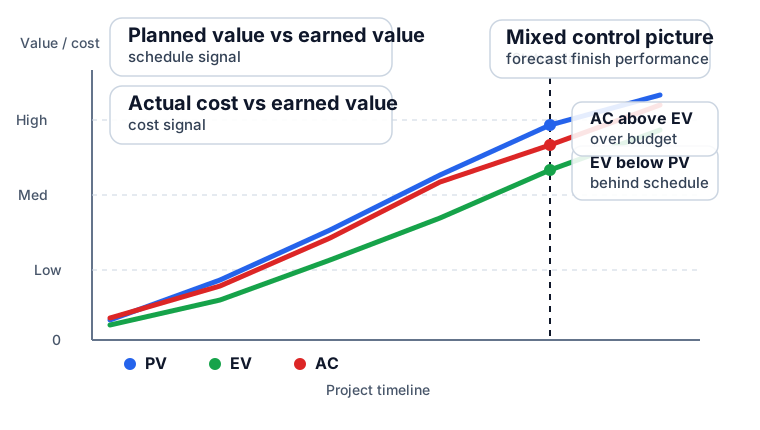
The reader should notice that the project is not just “spending money.” It is spending more than the value earned and earning less value than planned.
How To Read EVM Questions On The Exam
When CAPM gives you earned value data, ask:
- Is earned value below or above planned value?
- Is earned value below or above actual cost?
- Do the indexes confirm the same story?
- Is the project showing a mixed or consistent control pattern?
- Does leadership need a forecast because current conditions threaten the finish target?
That sequence usually gets you to the strongest answer faster than formula memorization alone.
Common Pitfalls
- memorizing formulas without understanding what they mean
- reading only one metric and ignoring the pattern
- assuming
EACis a promise rather than a forecast based on assumptions - confusing current variance with final outcome
- assuming a slightly positive signal in one area cancels a clearly weak signal elsewhere
Check Your Understanding
Sample Exam Question
Scenario: A project dashboard shows PV = 150, EV = 132, and AC = 148. The summary also shows CPI = 0.89, SPI = 0.88, and an EAC above the original BAC. The sponsor asks whether the project looks healthy and whether a forecast matters.
Question: How should the project manager read that dashboard?
- A. The project shows mild pressure, but no forecast is needed yet because the sponsor asked only for current status
- B. Forecasting can wait until closeout because the current variances already describe everything leadership needs to know
- C. The dashboard suggests mixed but manageable status, so the team should defer further interpretation until the next reporting cycle
- D. The project is showing cost and schedule weakness, and forecasting is relevant because leadership needs to understand likely finish performance
Best answer: D
Explanation: CAPM usually rewards reading the whole control pattern. Earned value is below both planned value and actual cost, so schedule and cost performance are both weak. The indexes below 1.0 reinforce that interpretation, and an EAC above BAC makes forecasting directly relevant because leadership wants to know the likely finish outcome, not only today’s variance picture.
Why the other options are weaker:
- A: Current status alone is not enough when the pattern already suggests finish performance may be weak.
- C: The values are not merely something to watch later; they already support a meaningful performance interpretation now.
- B: Forecasting is useful during control specifically because leadership wants to know where the project is likely headed.