CAPM Projects Versus Operations
Study CAPM Projects Versus Operations: key concepts, common traps, and exam decision cues.
Projects and operations must be separated clearly because CAPM often hides the right answer inside that classification step.
Why It Matters
When candidates confuse projects with operations, they choose the wrong governance model, the wrong artifacts, and the wrong owner. CAPM expects you to notice whether the work is creating change or sustaining an existing service, because that choice affects planning depth, funding, escalation paths, and closeout expectations.
The Boundary
| Work type | Core purpose | Typical signal |
|---|---|---|
| Project | Introduce, change, or retire a product, service, process, or capability | rollout, replacement, upgrade, relocation, launch |
| Operations | Sustain or run an existing product, service, or process | daily processing, ongoing support, routine maintenance |
Projects create or change capability. Operations run it once the organization accepts it into normal use.
Visual Guide
This boundary is easier to learn from a handoff visual than from a simple flowchart. CAPM usually wants you to see temporary change work on one side, the acceptance or transition point in the middle, and steady-state operational ownership on the other.
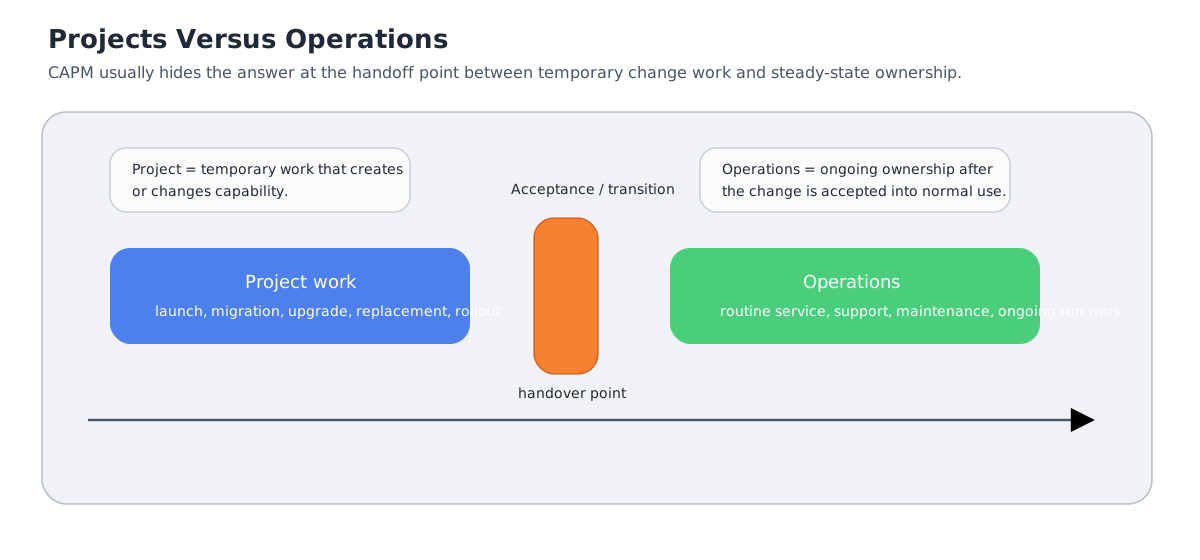
That handover point is where many CAPM questions hide the distinction.
Ongoing Importance Does Not Turn Work Into Operations
One common CAPM trap is presenting work that feels important, repetitive in effect, or central to the business and then tempting you to call it operations. Importance is not the deciding factor. The stronger question is whether the effort is primarily creating or changing a capability, or whether it is primarily sustaining an already accepted one.
This matters because major rollouts, upgrades, compliance changes, and process redesigns often support critical business functions while still being project work. Their importance to the business does not change the fact that they are temporary change efforts.
Operations Can Trigger Projects Without Becoming Projects
Another useful distinction is that operational pain often creates the need for a project. Recurring service failures, aging infrastructure, complaint volume, or manual effort may trigger a project to improve the situation. But the operational problem and the project response are not the same thing. CAPM usually rewards candidates who can see the ongoing business condition on one side and the temporary change initiative on the other.
That distinction helps with ownership too. Operations may define the need and later own the result, while the project team owns the temporary effort to deliver the change.
Handover Is The Decision Boundary
The clearest dividing line between project work and operations is usually acceptance and handover. Before that point, the team is still changing, building, or transitioning capability. After that point, the organization is running and supporting what was delivered. CAPM scenarios often hide the answer inside this boundary by mentioning stabilization, readiness, or transfer of ownership.
If the question emphasizes who now owns ongoing service, maintenance, or routine support, it is usually testing the move into operations.
Check Your Understanding
Sample Exam Question
Scenario: A company is migrating its warehouse scanners to a new platform. The implementation team will train staff, cut over sites, and stabilize the rollout. After that, the support desk will manage replacement devices and routine service issues.
Question: How should that scanner work be classified?
- A. The entire effort is operations because scanners are part of normal business
- B. The implementation is project work, and the later service support belongs to operations
- C. The entire effort remains a project because the scanners keep creating value
- D. The work is operations unless the scanner technology is completely novel
Best answer: B
Explanation: CAPM expects you to distinguish the temporary change initiative from the ongoing support model after handover.
Why the other options are weaker:
- A: A recurring business function can still require a temporary project to change it.
- C: Lasting value does not mean the project lasts forever.
- D: Novelty is not the core distinction.