CAPM Outputs, Outcomes, Benefits, and Value
Study CAPM Outputs, Outcomes, Benefits, and Value: key concepts, common traps, and exam decision cues.
Outputs, outcomes, benefits, and value form one of CAPM’s most useful mental ladders. It helps you separate what the project delivers from what the organization actually gains.
Visual Guide
This ladder works better as a visual progression than as a plain flowchart because CAPM tests the difference in level, not just the order. The key move is seeing the handoff from what the team delivers to what users change, then to measurable gain and wider organizational worth.
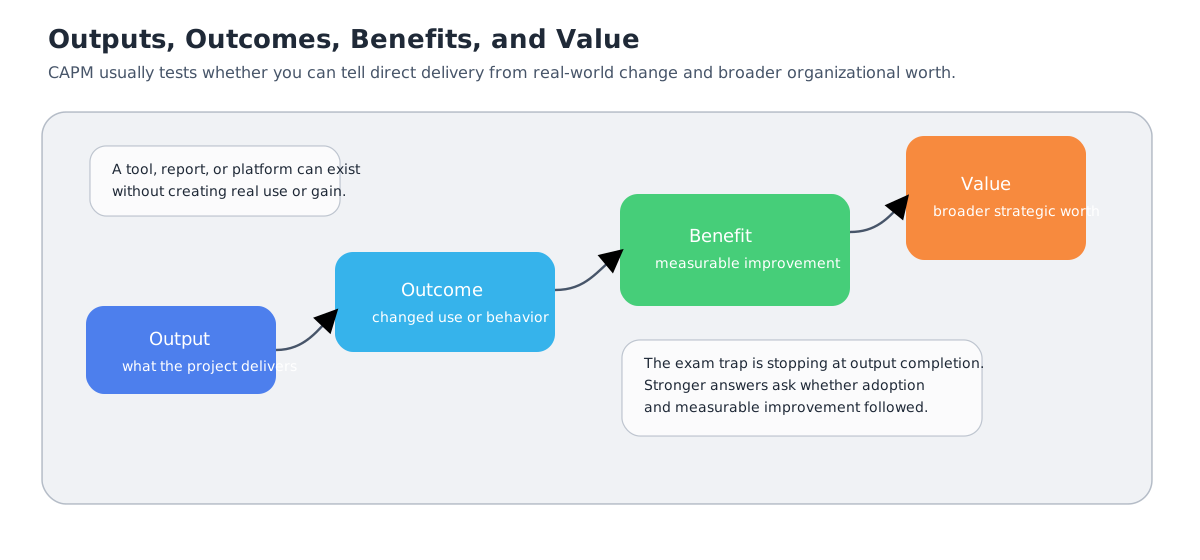
The project directly produces outputs. Outcomes appear when people use those outputs. Benefits describe the measurable improvement that follows. Value is the broader organizational worth created by those benefits.
Why It Matters
This distinction changes how success is judged. A team can complete an output and still be too early to claim real benefit. It can also produce a technically accepted deliverable that creates little value because adoption, fit, or business need is weak.
CAPM questions use this ladder to test whether you are looking at the right level of evidence.
How To Read It in Scenarios
- If the item is a deliverable the team hands over directly, it is probably an output.
- If the item describes changed behavior or improved capability in use, it is probably an outcome.
- If the item describes measurable business gain, it is probably a benefit.
- If the question asks what matters strategically, it is usually asking about value rather than mere completion.
Adoption Is Usually The Bridge Between Output And Outcome
One of the most useful CAPM distinctions here is that projects usually create outputs directly, but outcomes depend on adoption and use. That means a team can complete its deliverable correctly while the organization is still too early to claim meaningful outcome or benefit. If users avoid the new workflow, bypass the new tool, or keep using the old process, the output exists but the ladder has not advanced very far.
This is why transition, training, handover, and stakeholder readiness matter later in the guide. They help move the project from completed output toward real outcome.
Benefits Need Evidence, Not Assumption
CAPM often tests whether candidates are claiming too much too early. A dashboard going live is not automatically a benefit. A new portal launch is not automatically improved service. Benefits usually require some measurable evidence that the output changed performance, behavior, cost, speed, quality, or risk in a useful direction.
That is the practical exam move: ask what level of proof the scenario actually gives you.
Value Is Wider Than One Good Metric
Candidates also weaken this ladder by collapsing value into one visible gain. CAPM treats value as broader organizational worth. A project can show one positive metric and still produce limited value if adoption is weak, support costs rise, or the business problem remains only partly solved. That broader reading helps when the scenario offers mixed signals.
Check Your Understanding
Sample Exam Question
Scenario: A project team completes an automated expense-reporting tool. Usage remains low because managers still insist on manual approval methods. The project sponsor says the project should be declared a full success because the output is live.
Question: Which interpretation of the sponsor’s success claim is strongest?
- A. Agree, because once an output is delivered, outcomes and benefits can be assumed
- B. Disagree, because outputs do not matter in CAPM
- C. Agree, because value and benefits are the same as technical completion
- D. Disagree, because the output exists, but the expected outcomes and benefits still depend on real adoption and changed behavior
Best answer: D
Explanation: The project has produced an output, but the desired outcomes and benefits are not yet fully realized if adoption remains weak. CAPM expects candidates to distinguish those layers.
Why the other options are weaker:
- A: Outputs do not guarantee outcomes.
- C: Technical completion is not the same as realized value.
- B: Outputs absolutely matter; they are just not the whole story.