CAPM Functional vs Nonfunctional Requirements
Study CAPM Functional vs Nonfunctional Requirements: key concepts, common traps, and exam decision cues.
Functional and nonfunctional requirements matter because a requirement set is weaker when it describes system behavior but ignores the quality, performance, security, accessibility, or control conditions that make that behavior acceptable. CAPM often tests whether you can separate those two kinds of requirement clearly.
The Basic Distinction
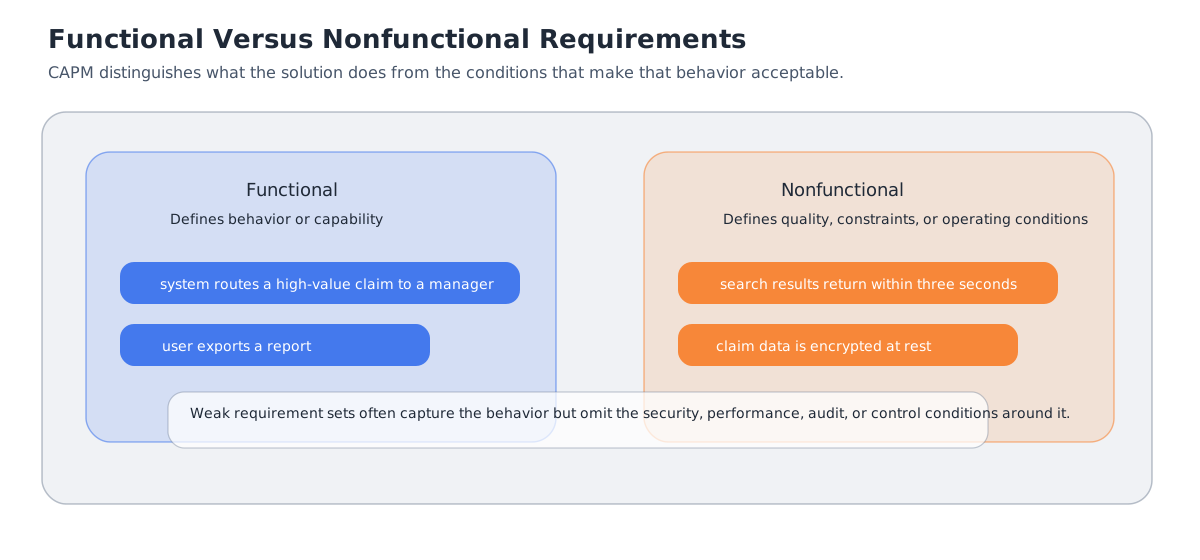
Functional requirements describe what the solution must do. They define behavior or capability, such as routing a claim, generating a report, or sending an alert.
Nonfunctional requirements describe how well, under what conditions, or within what constraints the solution must perform that behavior. They often cover areas such as response time, availability, security, accessibility, retention, privacy, or auditability.
Both matter. One is not automatically more real than the other.
CAPM often tests this distinction with short statements that look similar at first glance. The right answer usually depends on whether the statement defines a capability or defines a condition around that capability. When candidates miss that difference, they often treat critical quality or control requirements as if they were optional implementation details.
Why CAPM Tests This
The exam often uses short statements that look similar on the surface:
- “The system sends an approval notification.”
- “The notification must be sent within five seconds and stored for audit review.”
The stronger answer focuses on what the statement is actually doing. The first is behavior. The second is quality and control conditions around behavior.
That is why strong requirement thinking usually keeps both layers visible. A system might perform the required function and still fail if it is too slow, insecure, inaccessible, or noncompliant. CAPM usually treats those conditions as real requirements, not as nice-to-have refinements that can always be inferred later.
Visual Guide
This comparison is more useful than a decision tree because CAPM often gives short statements that look similar but live at different levels. The real distinction is whether the statement defines behavior or defines the quality, control, security, or performance conditions around that behavior.
Why The Distinction Matters In Delivery
| If only functional requirements are visible | If both functional and nonfunctional requirements are visible |
|---|---|
| The team may build the feature but miss acceptance conditions | The team understands what success looks like in operation |
| Security, performance, or retention needs can surface late | Quality and control expectations shape design earlier |
| Testing may focus only on behavior | Testing can also verify quality thresholds and constraints |
| Compliance gaps may appear after delivery work is already advanced | Control requirements are visible sooner |
CAPM usually rewards the stronger second pattern. A requirement set is not stronger just because it contains more behavior statements.
Functional And Nonfunctional Work Together
These two types usually support each other:
- a functional requirement tells the team what capability is needed
- a nonfunctional requirement tells the team the conditions that make that capability acceptable
For example, “users can upload supporting documents” is incomplete if the context also requires encryption, file-size limits, accessibility, auditability, or retention. CAPM often tests whether you can see that a requirement set can be functionally correct but still operationally weak.
Example
If a requirement says users can upload supporting documents, that is functional. If another says uploaded documents must be encrypted at rest and retained for seven years, that is nonfunctional because it describes security and retention conditions rather than the basic behavior itself.
If the team documents only the upload behavior and waits to address retention and encryption later, it may still deliver a feature that fails security review or audit expectations. CAPM usually favors making those conditions explicit early.
Exam Scenario
A BA documents that case managers can submit customer files through a portal. Later, the audit team asks where retention, encryption, and access-control expectations were defined. The BA replies that the portal upload requirement already exists.
The strongest CAPM interpretation is that the behavior requirement is only part of the story. The nonfunctional control conditions still need to be stated clearly in the requirement set.
Common Pitfalls
- assuming nonfunctional requirements are optional or secondary
- treating performance or security expectations as if they will be obvious without documentation
- using vague quality language such as “fast” or “user-friendly” without measurable meaning
- documenting only the behavior and forgetting the conditions that make the behavior acceptable
- assuming developers or auditors will infer missing quality expectations automatically
- using nonfunctional labels without making the condition specific enough to verify
Check Your Understanding
Sample Exam Question
Scenario: A team documents that users can submit expense claims through a mobile app. Later, security reviewers discover that nothing in the requirements defines authentication strength, encryption, or data-retention expectations.
Question: How should the requirement set be corrected?
- A. Treat security expectations as optional because the functional requirement already exists
- B. Convert every nonfunctional expectation into a developer task and remove it from the requirement set
- C. Add the missing nonfunctional requirements so the behavior is supported by the required security and control conditions
- D. Assume developers will infer all needed quality conditions without them being stated
Best answer: C
Explanation: The stronger response recognizes that behavior alone does not define the solution well enough; the quality and control conditions matter too.
Why the other options are weaker:
- A: Functional behavior does not automatically cover security, performance, or compliance conditions.
- B: Implementation tasks do not replace the need to state the requirement clearly.
- D: Unwritten quality expectations often become defects, audit gaps, or rework later.