CAPM Decision Rights, Escalation Paths, and RACI Logic
Study CAPM Decision Rights, Escalation Paths, and RACI Logic: key concepts, common traps, and exam decision cues.
Decision rights determine who can approve, who should be consulted, who needs to be informed, and when a problem must move upward. CAPM questions often test this indirectly by showing a decision that is being made at the wrong level.
What Decision Rights Actually Mean
A team works faster when authority boundaries are clear. Some decisions belong inside the project team. Others require sponsor backing, governance review, or functional approval. The project manager should know where the authority line sits and escalate when the issue crosses it.
RACI-style logic helps because it separates different kinds of involvement:
- responsible: does the work
- accountable: owns the result
- consulted: gives input before a decision
- informed: needs the result communicated
CAPM does not require you to turn every scenario into a formal RACI chart, but it often rewards the same logic.
The Strongest Decision Usually Stays At The Lowest Valid Level
Good governance does not mean escalating everything upward. A strong project response keeps the decision at the lowest level that has enough authority, information, and accountability to handle it properly.
That is why CAPM often rewards selective escalation:
- keep operational decisions within the team or project level when authority exists
- escalate when the issue crosses budget, contract, strategic, or policy boundaries
- avoid both extremes: unnecessary escalation and improper self-approval
This is less about hierarchy than about correct decision fit.
Escalation Is Not Failure
Candidates sometimes read escalation as weakness. That is the wrong frame. Escalation is a control action used when the project team lacks enough authority, resources, or influence to resolve the issue appropriately.
Good escalation usually has three traits:
- the issue is clearly defined
- the impact is explained
- the requested decision or support is specific
A vague escalation wastes time. A precise escalation protects the project.
Escalation Quality Depends On The Request
An issue log entry by itself is not always enough. When escalation is needed, the stronger response usually states:
- what happened
- what impact is expected
- what options were considered, if known
- what decision, resource, or approval is needed
This matters because many weak CAPM answers escalate noise rather than decision-ready information. The stronger answer prepares the issue so the higher-level role can act.
Example
A team learns that a vendor delay will affect a committed milestone. The project manager should first confirm the impact and evaluate response options. If the contract change, funding effect, or customer commitment exceeds project-level authority, escalation is appropriate. The stronger answer is not to hide the issue or wait for it to solve itself.
RACI Logic in Plain English
| Situation | Stronger ownership pattern |
|---|---|
| Technical task delivery | team member is responsible |
| Overall outcome and coordination | project manager is usually accountable at project level |
| Strategic backing or major approvals | sponsor or governance body may be accountable |
| Specialized input before a decision | consulted stakeholder |
| Broad communication after the decision | informed stakeholder group |
The main exam lesson is simple: not everyone who touches a decision owns it.
RACI Helps Prevent Approval And Communication Gaps
RACI logic is especially useful when several roles are involved and the team risks confusing participation with authority. If many people are consulted but no one is clearly accountable, the project drifts. If everyone is informed but no responsible role is named, the work stalls.
A RACI or responsibility assignment matrix does not solve every people problem, but it does make approval, execution, and communication boundaries easier to see before the project discovers them through delay.
Visual Guide
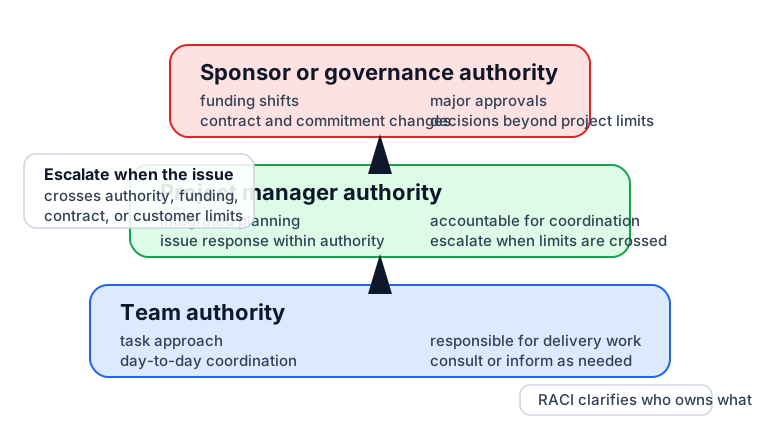
The ladder below separates decisions that can stay with the team from those that should move to the project manager or a sponsor or governance body. CAPM usually rewards escalation only when the issue crosses the current authority boundary.
Check Your Understanding
Sample Exam Question
Scenario: A project team discovers that a requested change will affect budget, schedule, and a contract commitment with an outside supplier. The project manager has confirmed the impact but does not have authority to approve the funding shift.
Question: What is the strongest next action?
- A. Escalate the issue with clear impact information and request the needed approval decision
- B. Approve the change informally so the project can move faster
- C. Ask the team to work overtime until the problem disappears
- D. Delay communication until the next status report because escalation may alarm stakeholders
Best answer: A
Explanation: The project manager has already identified that the issue exceeds current authority. The strongest next move is a clear escalation with defined impact and a specific decision request. CAPM usually rewards escalation that is precise, timely, and aligned to the real authority boundary.
Why the other options are weaker:
- B: The project manager does not have the required approval authority.
- C: Overtime is not a substitute for an authorized decision.
- D: Waiting increases risk and weakens control.