CAPM Stakeholder Identification for Requirements
Study CAPM Stakeholder Identification for Requirements: key concepts, common traps, and exam decision cues.
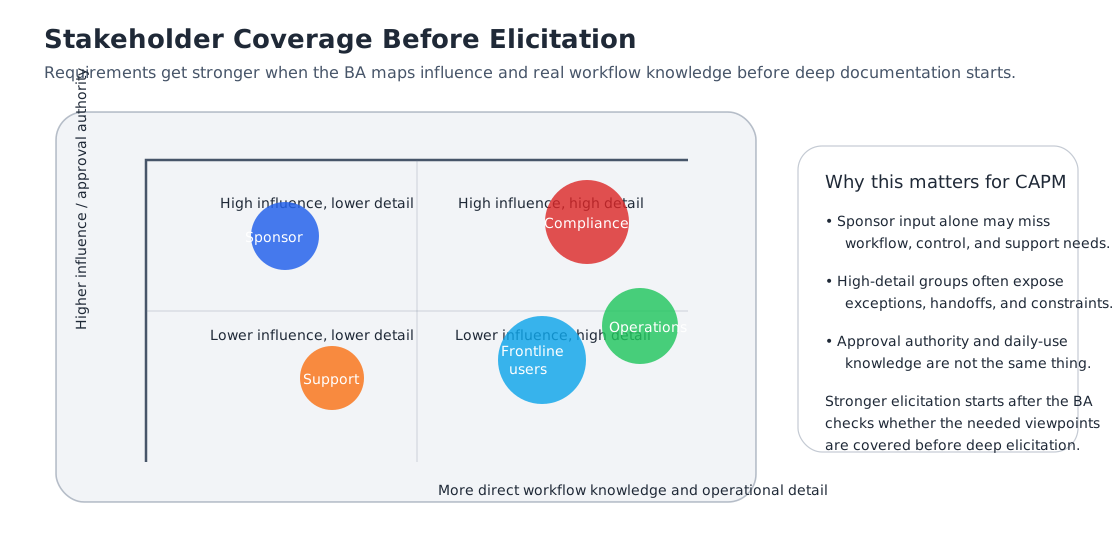
Stakeholder identification matters in business analysis because requirement quality depends on whose voice is present before detailed elicitation begins. CAPM often tests whether you understand that weak stakeholder coverage leads directly to missed constraints, incomplete needs, and avoidable rework.
Why Identification Comes First
If the team starts gathering requirements from the most available person, it may collect information quickly but still miss the people who know the real workflow, control boundaries, support needs, or approval conditions. Stakeholder identification is the step that prevents that narrow start from becoming the project’s default view.
This is why CAPM often rewards the answer that broadens coverage before the analyst goes too deep into documenting specifics.
That point matters because business-analysis mistakes often begin before any requirement is written down. If the wrong people shape the early understanding, the whole requirement set can become biased toward one perspective. CAPM usually rewards candidates who treat stakeholder identification as an early quality-control step, not as an administrative list-making exercise.
What Better Stakeholder Coverage Improves
Early identification improves:
- the range of needs captured
- awareness of operational and compliance constraints
- clarity about who must review, influence, or approve
- the analyst’s choice of elicitation method later
Different groups usually see the future solution differently. Users care about day-to-day workflow. Sponsors care about value and timing. Operations teams care about maintainability and handoff. Compliance stakeholders care about control obligations. Missing one of those views can distort the whole requirement set.
Stakeholder identification also improves communication planning. Once the analyst knows who is involved and why, it becomes easier to choose the right workshop participants, the right level of detail, and the right approval path. CAPM often tests stakeholder coverage as the foundation for later communication choices, not as a separate isolated step.
Visual Guide
This stakeholder map works better than a simple sequence diagram because the core lesson is coverage, not just order. CAPM usually rewards recognizing that sponsor influence, user workflow knowledge, operational support, and compliance control needs all sit in different places and should not be collapsed into one voice.
What Good Stakeholder Identification Changes
| If stakeholder identification is weak | If stakeholder identification is strong |
|---|---|
| Requirements reflect one dominant voice | Requirements reflect multiple relevant perspectives |
| Constraints appear late | Constraints are surfaced earlier |
| Approval paths stay unclear | Decision and approval roles become clearer |
| Rework appears after requirements seem “finished” | Blind spots are reduced before deeper analysis |
CAPM usually rewards the stronger pattern. Early stakeholder identification protects the quality of what comes next.
What CAPM Usually Wants
The exam often hides this topic inside a simple scenario: the team starts with sponsor input and later discovers that users or compliance reviewers should have been involved earlier. The stronger answer usually fixes the stakeholder coverage problem first instead of trying to keep documenting partial requirements.
CAPM may also test whether one stakeholder can represent everyone. Usually not. One stakeholder may represent one perspective well, but business analysis improves when the analyst recognizes the missing perspectives before they become downstream conflict.
Another common trap is assuming that seniority equals completeness. A sponsor may understand business urgency and value, but still miss day-to-day user friction, operational maintenance issues, or control requirements. CAPM usually favors broader coverage over title-driven shortcuts.
Stakeholder Identification As BA Control
Good BA communication starts with a few practical questions:
- who uses the outcome directly
- who approves or funds it
- who supports or operates it
- who imposes required constraints
- who can clarify domain rules the team might otherwise guess incorrectly
The analyst does not need every person in every meeting, but does need to know which perspectives are missing before the team claims the requirements are complete.
Example
A sponsor requests a new onboarding workflow and provides a clear business objective. Later, the team learns that the operations group uses a manual exception process, the compliance team needs explicit consent tracking, and frontline users have a very different view of where customers get stuck. The stronger response would have identified those groups before detailed requirements were drafted.
If the team continues drafting detailed requirements before fixing stakeholder coverage, the resulting documentation may look complete while still being structurally weak. CAPM usually treats that as a preventable business-analysis failure.
Exam Scenario
A BA is assigned to define requirements for a new internal escalation process. The sponsor provides a strong business case and wants the team to move quickly, but no one has yet involved frontline users, the operations team, or the audit/compliance reviewer.
The strongest CAPM response is to broaden stakeholder identification before the BA goes deeper into requirement detail. The schedule pressure does not remove the need for correct coverage.
Common Pitfalls
- gathering requirements from only the loudest stakeholder
- assuming sponsor input covers user, operational, and compliance concerns
- forgetting that approval stakeholders and working stakeholders may be different
- treating stakeholder identification as a checkbox instead of a quality control step
- confusing availability with relevance
- documenting detailed requirements before the stakeholder set is credible
Check Your Understanding
Sample Exam Question
Scenario: A BA begins documenting requirements for a new internal approval process based only on sponsor interviews. Two weeks later, the team learns that frontline users, compliance reviewers, and operations support staff all have important needs that were not considered.
Question: What should the BA do before going deeper into documentation?
- A. Keep using sponsor input only because additional perspectives will slow the work down
- B. Continue documenting the current requirements first and identify other stakeholders after design
- C. Assume the missing groups can add their concerns informally after delivery begins
- D. Broaden stakeholder identification before going deeper so the requirement set reflects the people and constraints that actually matter
Best answer: D
Explanation: The stronger response fixes the requirement-coverage problem at its source by identifying the broader stakeholder set before the analysis goes deeper.
Why the other options are weaker:
- A: Speed does not justify building from a known blind spot.
- B: Delaying stakeholder expansion makes the resulting rework more expensive.
- C: Late discovery of major needs is usually harder, not easier, to absorb.