CAPM User Stories and Story Structure
Study CAPM User Stories and Story Structure: key concepts, common traps, and exam decision cues.
User stories matter because adaptive teams need requirement statements that are small enough to discuss, prioritize, and refine without pretending that every need must start as a full predictive specification. CAPM often tests whether you understand what a story is good for and where its limits begin.
Why Stories Work
A user story is usually a compact expression of who needs something, what they need, and why it matters. Its value is not just the sentence template. Its value is that it keeps the team centered on user outcome and business need instead of jumping too quickly into detailed implementation talk.
A good story is a starting point for conversation, not the end of the analysis.
That distinction matters because CAPM often tests stories as communication tools, not as magic mini-specifications. A story helps the team focus on value and user need, but it still has to be refined before it becomes reliably buildable, testable, and ready for commitment.
What Story Structure Is Trying To Preserve
Strong story structure usually preserves three things:
- the user or stakeholder perspective
- the needed capability or outcome
- the reason that need matters
That structure helps the team discuss value and priority early. It also helps the analyst spot weak stories that are really just hidden technical tasks or oversized epics in disguise.
When a story loses one of those pieces, it often becomes weaker immediately. If the user perspective disappears, the item may turn into a technical activity with no visible business value. If the value disappears, the team may struggle to prioritize it. If the scope is too broad, the story may become a vague container for several different needs.
Visual Guide
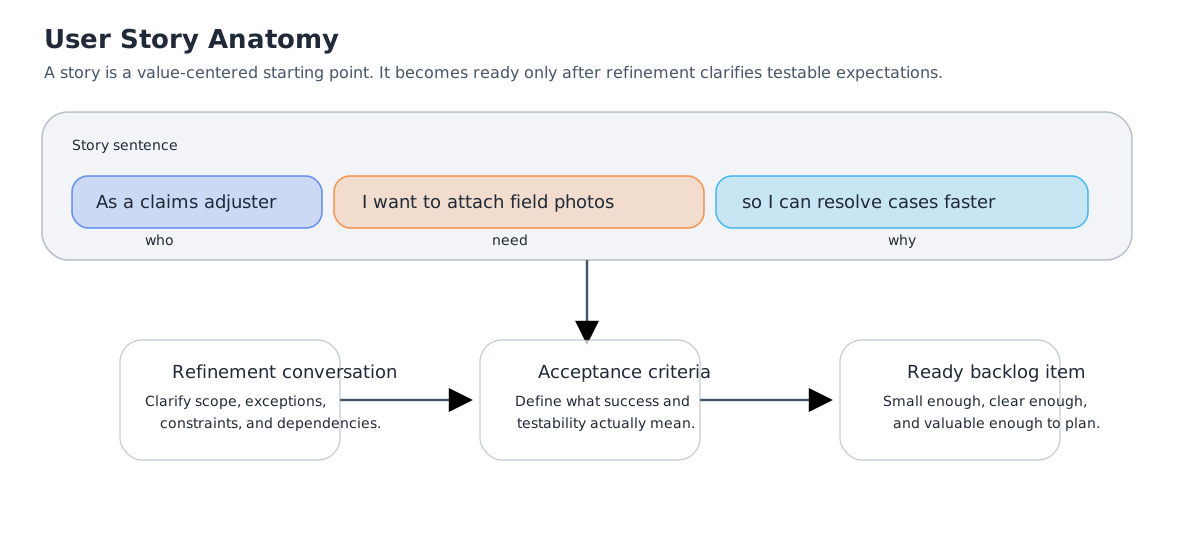
This anatomy view is more useful than a generic flowchart because the main teaching point is the shape of the story itself. CAPM wants you to see the who, need, and why, then recognize that a story still needs refinement and acceptance criteria before it is really ready.
Stories Versus Ready Work
| A strong story gives the team… | A ready backlog item still also needs… |
|---|---|
| user-centered need framing | clarified scope boundaries |
| a basis for value discussion | acceptance criteria |
| a useful unit for refinement and prioritization | enough detail to support estimation and testing |
| a lighter adaptive format than full specification | confirmation that the item is not too large or ambiguous |
CAPM usually rewards recognizing this difference. A good story is useful, but it is not automatically ready.
What CAPM Usually Wants
The exam often asks whether a story is ready, what stories are for, or why the team still needs conversation and acceptance criteria after writing one. The strongest answer usually recognizes that:
- a story is lightweight by design
- it still needs refinement
- it should stay tied to user value
The weaker answer often treats the story sentence as complete on its own.
Another common trap is confusing a user story with a task. “Update API endpoint” or “refactor auth module” may be real work items, but they do not function as strong user stories unless the user value and need are still visible. CAPM usually favors requirement language that keeps the outcome clear before the team decomposes into technical work.
Acceptance Criteria And Story Quality
A user story becomes much stronger when acceptance criteria make success testable. That is why a good CAPM answer often pairs the story with clearer conditions such as:
- what must happen
- what exceptions matter
- what conditions define done for this item
Without that layer, the team may agree on the general idea of the story while still disagreeing about the behavior that counts as acceptable.
Example
A team writes, “As a claims adjuster, I want to attach supporting images so I can resolve cases faster from the field.” That is a useful starting point because it expresses user, need, and value. It still needs discussion about file limits, security expectations, supported devices, and acceptance conditions before it should be treated as ready for delivery.
If the team immediately commits that story without clarifying those points, the resulting delivery may still miss what “ready” or “acceptable” actually meant. CAPM usually treats that as a weak preparation choice, not as a strength of agile minimalism.
Exam Scenario
A backlog item reads, “As a customer, I want better account management.” The team assumes that is enough detail because user stories should stay lightweight, and it plans to break it into tasks during the iteration.
The strongest CAPM response is to keep the user-value framing, but refine the story into something smaller and more testable, with acceptance criteria that clarify what “better account management” actually means.
Common Pitfalls
- treating the story sentence as if it fully replaces clarification
- writing technical tasks and calling them stories
- ignoring acceptance criteria because the story seems easy to understand
- leaving one story so large that it hides several separate needs
- assuming lightweight format means weak readiness standards are acceptable
- losing the user outcome while decomposing into technical work
Check Your Understanding
Sample Exam Question
Scenario: A team writes, “As a customer, I want to manage my profile,” and immediately marks the story ready for delivery. No one has clarified which profile actions matter, what conditions define success, or what acceptance criteria will be used.
Question: What should the team do before marking that story ready?
- A. Treat the story as fully ready because adaptive teams should keep requirements minimal
- B. Convert the story directly into technical tasks without clarifying user value first
- C. Remove the story completely because adaptive teams should avoid documenting needs
- D. Refine the story into clearer scope and add acceptance criteria before treating it as ready work
Best answer: D
Explanation: The stronger response preserves the lightweight story but adds the refinement needed to make it understandable, testable, and usable for delivery.
Why the other options are weaker:
- A: Minimal format does not remove the need for clarity.
- B: Jumping to technical tasks too early can lose the user outcome.
- C: Adaptive delivery still depends on discussable and documented needs.