CAPM Requirements Traceability Matrix
Study CAPM Requirements Traceability Matrix: key concepts, common traps, and exam decision cues.
A requirements traceability matrix matters because predictive and more controlled environments often need visible linkage from requirement to deliverable to test or acceptance evidence. CAPM usually tests this as a practical control question, not as a template-memorization exercise.
What An RTM Is Trying To Protect
An RTM helps the team answer questions such as:
- where did this requirement come from
- which deliverable or feature is supposed to satisfy it
- how will the team validate it
- what else is affected if it changes
That visibility matters most when requirements are more structured, approval paths are formal, or control evidence may need to be shown later.
CAPM usually treats that linkage as a control strength, not as bureaucracy. If a reviewer asks whether a requirement was implemented, tested, and accepted, the team needs more than memory. The RTM gives the project a visible relationship chain from requirement to downstream evidence.
Why CAPM Cares
The exam often contrasts the need to prioritize work with the need to prove coverage and linkage. A traceability matrix is strongest when the team must maintain requirement relationships clearly over time, especially across design, test, validation, and approved change.
This does not mean every environment needs a large formal matrix. It means CAPM expects you to understand the control logic the RTM provides.
That logic is especially important in environments with governance, auditability, sign-off expectations, or structured handoffs between analysis, design, testing, and validation. CAPM usually rewards candidates who know when visible linkage matters more than a simple working list of tasks.
Visual Guide
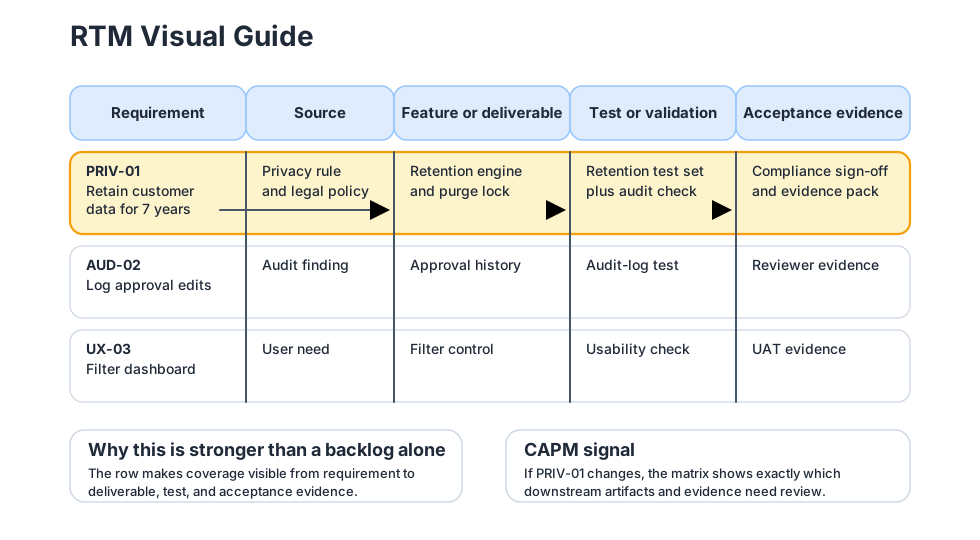
An RTM is easiest to understand when you can see the row structure directly. The highlighted requirement below shows the control logic CAPM is testing: one requirement should stay visibly linked to its source, its delivered feature, the test or validation step, and the acceptance evidence.
What The RTM Adds Beyond A Requirement List
| Without clear traceability | With traceability visible |
|---|---|
| Teams may know the requirement exists but not where it is proved | Requirement coverage can be followed through delivery and testing |
| Change impact is harder to see | Linked artifacts affected by change are easier to identify |
| Acceptance evidence may stay disconnected | Validation can be tied back to the original requirement |
| Audit or control questions depend on memory | The relationship chain is explicit |
CAPM often rewards the second pattern because it supports both control and impact analysis.
What CAPM Usually Wants
The strongest answer usually recognizes that an RTM is not mainly for prioritization. It is for linkage, coverage, and impact visibility. If a scenario asks how to show that a regulatory requirement was implemented and validated, the RTM logic is often the right answer.
The weaker answer often assumes that a backlog, meeting note, or memory of the team is enough to answer a traceability question later.
Another weak answer is to treat traceability as something added only after delivery is complete. CAPM usually favors keeping the links alive while the work is being analyzed, built, tested, and changed so that coverage and impact remain visible throughout delivery.
RTM Use In Practice
Strong RTM use usually supports questions such as:
- has every requirement been addressed by some deliverable or feature
- which tests or validation steps prove it
- what happens elsewhere if this requirement changes
- which requirements still lack acceptance evidence
That makes the RTM useful not only for governance, but also for practical delivery control.
Example
Suppose a compliance reviewer asks how one data-retention requirement is reflected in delivered behavior and test coverage. A backlog may show that related work was scheduled, but an RTM or equivalent traceability structure is stronger when the question is about proof of coverage and linkage.
If the team can show the requirement, the linked implementation element, the associated test, and the acceptance evidence, it can answer the reviewer clearly. If not, the team may only be able to say that work was “probably covered,” which is usually too weak in a controlled setting.
Exam Scenario
A regulated requirement has been approved, built, and tested, but a reviewer now asks the team to show the path from the original requirement to the delivered feature and the exact validation evidence. The team has backlog entries and meeting notes, but no explicit link chain.
The strongest CAPM response is to establish or use an RTM-style traceability view so the requirement can be followed through delivery and acceptance clearly.
Common Pitfalls
- using the RTM as if it were the main prioritization tool
- linking requirements to deliverables but not to validation evidence
- assuming traceability matters only after implementation
- forgetting to refresh the matrix when requirements change
- treating visible linkage as optional in environments that clearly require proof
- relying on team memory instead of explicit relationship tracking
Check Your Understanding
Sample Exam Question
Scenario: A team working in a controlled environment is asked to show how a mandatory privacy requirement was translated into delivered functionality and then validated. The team has backlog items, but no clear trace from the requirement to test evidence.
Question: What should the team add to close that control gap?
- A. Reprioritize the backlog so privacy-related items stay near the top and their importance remains visible
- B. Ask testers to sign off the feature without adding any linkage artifact, since the work is already complete
- C. Use or build traceability support such as an RTM so the requirement can be followed through delivery and validation clearly
- D. Add a release note stating that privacy was considered during development
Best answer: C
Explanation: The stronger response recognizes that coverage and validation visibility require more than prioritized work items.
Why the other options are weaker:
- A: Priority does not automatically prove requirement satisfaction or validation.
- B: Sign-off without visible linkage still leaves the control gap unresolved.
- D: A release note is weaker than explicit traceability from requirement to evidence.