CAPM Verification, Validation, and Acceptance
Study CAPM Verification, Validation, and Acceptance: key concepts, common traps, and exam decision cues.
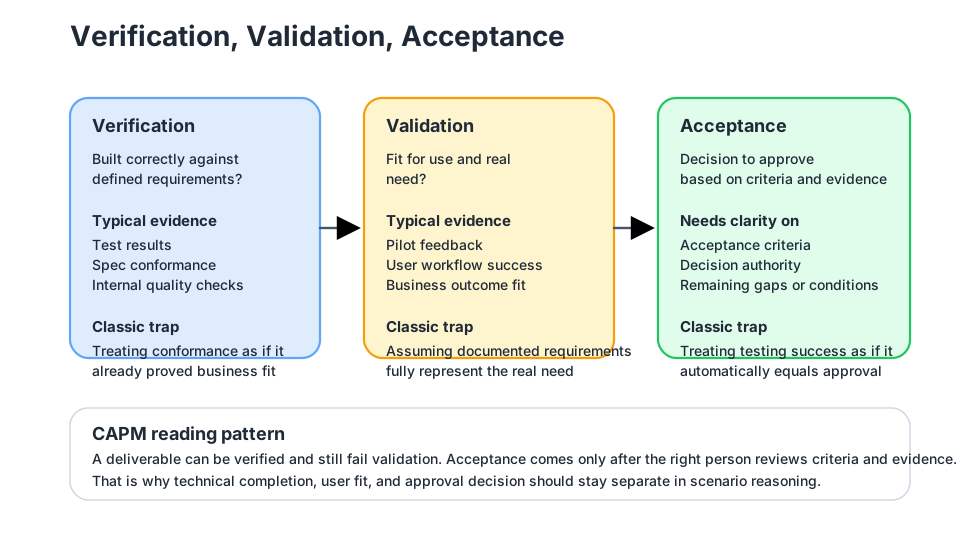
Verification, validation, and acceptance sound similar, but CAPM expects you to keep them distinct. Verification asks whether the deliverable was built correctly against defined requirements. Validation asks whether the result actually meets user needs and intended value. Acceptance is the decision to approve the result based on agreed criteria and evidence.
Verification Versus Validation
Verification is inward-looking. It compares the work product against specifications, requirements, or internal quality expectations. Validation is outward-looking. It considers whether the completed output is fit for use and solves the intended problem for the stakeholder or end user.
CAPM often rewards the answer that understands both are necessary. A deliverable can be verified and still fail validation if it technically matches the documented requirement but does not solve the real business need.
Acceptance Criteria Must Be Objective
Acceptance gets weak quickly when the criteria are vague. Statements such as “works well,” “looks good,” or “users seem happy” are too loose to support a reliable decision. CAPM usually rewards the answer that turns acceptance into something observable: required outputs, expected behaviors, tolerance limits, approval conditions, or scenario results that can be checked directly.
That matters because verification, validation, and acceptance all depend on evidence. If the criteria are fuzzy, the team may argue about whether the result is done even when everyone reviewed the same deliverable.
Acceptance Is A Decision, Not A Feeling
Acceptance requires criteria, evidence, and an authorized decision. In some contexts that means formal sign-off. In other contexts it may mean product-owner approval, business confirmation, or operational handoff evidence. The stronger response asks:
- what criteria define acceptance
- who has authority to accept
- what evidence supports the decision
- what defects, gaps, or conditions remain
What Changes The Answer
This topic often turns on one of four distinctions:
- whether the question is asking about conformance to requirements or fit for use
- whether the remaining issue is a defect, a missing requirement, or a business-need gap
- whether formal sign-off is required by governance or whether product/business acceptance is enough
- whether the evidence supports acceptance now or shows that more validation is still needed
Visual Guide
The comparison below shows why these three terms should stay separate in CAPM reasoning. Verification checks conformance, validation checks real-world fit, and acceptance is the decision that follows from criteria, authority, and evidence.
Example
A team delivers a new reporting screen exactly as documented. Testing shows the filters work and the calculations are correct. Verification looks strong. But operations users then explain that the report still cannot support the actual weekly compliance review because the export format is unusable. Validation is weak even though verification succeeded.
That distinction is classic CAPM material.
Defects, Gaps, And Next Steps
Validation work often reveals more than simple pass/fail results. Sometimes the team finds a true defect against agreed requirements. Sometimes the team discovers that the requirement itself was incomplete or did not reflect actual user needs. CAPM usually rewards the answer that classifies the gap correctly before deciding what to do next.
If the issue is a defect against accepted criteria, correction and retest are usually strongest. If the issue exposes a missing business need, the stronger response may involve requirement updates, backlog or RTM changes, and a fresh acceptance decision later. Treating every failure as the same kind of problem is a weak exam pattern.
Traceability Through Acceptance
Requirements work does not end when testing starts. A strong CAPM response often keeps the requirement linked through test evidence, review outcomes, unresolved issues, and final acceptance. In predictive environments this may mean explicit RTM updates. In adaptive environments it may mean backlog status, acceptance evidence, and delivered increment records. The core idea is the same: acceptance should be supported by visible traceability, not by memory.
What CAPM Usually Wants
The stronger exam response usually:
- checks acceptance criteria early
- confirms who owns the acceptance decision
- uses test or review evidence, not assumptions
- distinguishes technical completion from business readiness
The weaker response treats stakeholder satisfaction as automatic once development is finished.
Common Pitfalls
- using verification and validation as interchangeable terms
- assuming testing alone equals acceptance
- asking the wrong stakeholder to approve the result
- ignoring the real business use case behind the written requirement
Check Your Understanding
Sample Exam Question
Scenario: A team completes a new workflow tool. Internal testing confirms every documented requirement was met. During pilot use, however, managers report that the workflow still does not support the approval path they actually use in practice.
Question: How should the team classify that result?
- A. Acceptance should proceed because technical completion against documented requirements is the main proof point
- B. The deliverable passed validation because internal testing confirmed compliance with the documented requirement set
- C. The deliverable passed verification, but validation is still in doubt because the real user need may not be met in practice
- D. Verification is incomplete because pilot users found a workflow gap, so none of the earlier testing results matter
Best answer: C
Explanation: The tool appears to have been built correctly against documented requirements, so verification may be strong. But if actual use still fails to support the real approval path, validation remains weak.
Why the other options are weaker:
- A: Acceptance should depend on evidence and business fit, not technical completion alone.
- B: Testing against documented requirements does not automatically prove fit for use.
- D: Pilot failure raises a validation concern, but it does not erase the fact that the documented requirement set may have been verified.