PMP 2026 Cheat Sheet
High-yield PMP 2026 review for key rules, traps, decision cues, formulas, and final-week reminders.
Use this as your last-mile PMP 2026 review. Pair it with the Syllabus for the weighting map, the Study Plan for sequencing, and Sample Questions for scenario translation.
For exam-transition context and official policy details, see Overview. For the PMBOK 8 transition layer, use PMBOK 7 vs 8, AI Guidance, Sustainability, and Question Patterns.
If a miss points to a specific domain, repair it in the free guide before adding more timed volume: People, Process, or Business Environment.
Visual Guide
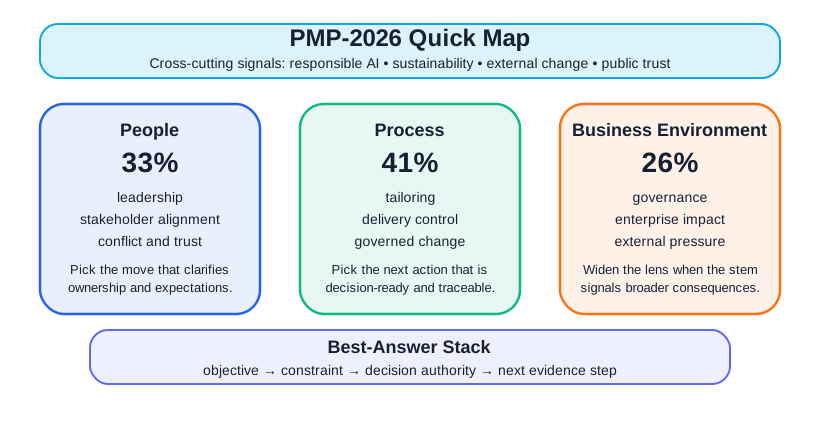
The updated exam still rewards classic PMP judgment, but it more often asks whether your next action remains defensible once enterprise consequences, responsible-technology signals, sustainability implications, and external change are visible in the scenario.
Domain weighting snapshot
| Domain | Weight | What it usually tests | Fast reminder |
|---|---|---|---|
| People | 33% | leadership, alignment, stakeholder judgment, conflict, team decisions | strengthen trust and clarity before forcing execution |
| Process | 41% | tailoring, planning, delivery control, artifacts, change, value flow | pick the next governed action, not the biggest action |
| Business Environment | 26% | governance, compliance, external change, enterprise impact, transition consequences | widen the lens when the stem signals broader consequences |
Best-answer stack
When choices look close, read the stem through this order:
| Step | Ask yourself | Stronger answer pattern |
|---|---|---|
| Objective | What value or outcome is the scenario trying to protect? | keeps the answer tied to benefit, not just activity |
| Constraint | What hard limit or trigger is in play? | respects risk, compliance, budget, timing, or sustainability pressure |
| Decision authority | Who must decide or approve next? | uses the right governance path instead of unilateral action |
| Next evidence step | What fact, artifact, or alignment is still missing? | clarifies first when the scenario is still ambiguous |
Cross-cutting signals that change the answer
| Signal in the stem | What it should change | Weak answer pattern |
|---|---|---|
| responsible AI or automation | require explainability, traceability, human review, and risk controls when material | treating “more automation” as automatically better |
| sustainability or external impact | check lifecycle effects, stakeholder consequences, and trade-offs across time horizons | optimizing delivery speed while ignoring wider impact |
| external change or disruption | reframe assumptions, dependencies, and escalation thresholds quickly | forcing the old plan without checking whether context changed |
| public trust, regulatory, or enterprise consequence | widen the decision frame beyond the local project team | solving only the local task while ignoring governance exposure |
People domain quick rules
| If the question is about… | Usually stronger next move | Usually weaker move |
|---|---|---|
| conflict | surface the real interest, then facilitate resolution | imposing a solution before understanding the cause |
| stakeholder resistance | clarify impact, interests, and influence first | flooding stakeholders with more status updates only |
| unclear roles or expectations | align on ownership, decisions, and success criteria | asking the team to “work it out” without structure |
| knowledge transfer | make it explicit, scheduled, and owned | assuming handoff happens automatically at the end |
Process domain quick rules
| If the question is really asking about… | Reach for… | Why |
|---|---|---|
| tailoring the approach | predictive, agile, or hybrid fit | match uncertainty, compliance pressure, and feedback needs |
| what artifact comes next | charter, backlog, plan, register, or change analysis | use the missing artifact that unlocks the next decision |
| change | impact analysis plus approval path | protect value and traceability before implementing |
| risk vs issue confusion | risk register for uncertainty, issue log for current problems | the wrong artifact usually signals the wrong next action |
| acceptance and transition | criteria, readiness, and operational ownership | delivery is not done until the outcome can be sustained |
Business Environment quick rules
| Scenario type | What stronger answers do | What weaker answers do |
|---|---|---|
| compliance or governance pressure | escalate through the right threshold and document the decision basis | bypass approval because the team is under time pressure |
| organizational change | check adoption, readiness, and downstream operating impact | focus only on project completion |
| supplier or external dependency shock | recheck contract, interface, risk, and sequencing assumptions | keep the same plan and hope execution recovers |
| sustainability or public-impact signal | widen the recommendation to include enterprise and stakeholder consequences | treat it as a branding issue instead of a decision issue |
Fast elimination rules
- If a response implements a major change before analysis or approval, it is often wrong.
- If the stem is still ambiguous, clarify objective, constraint, or decision authority before acting.
- If the scenario adds new technology, sustainability, or external-change language, do not overreact. First ask whether it actually changes the decision.
- If multiple choices are plausible, choose the one that protects traceability, governance, and long-term value rather than only local speed.
How to use this cheat sheet
- Read one weak domain in the Syllabus or the matching chapter.
- Rehearse the relevant table here out loud before you drill.
- Do 10 to 25 questions in Practice.
- Add every repeated miss as a one-line “better answer” rule under the right section.
Free Guide vs Practice
This cheat sheet is the free review layer. When you want timed repetition, use the PMP 2026 practice page on external practice and return here to convert repeated misses into sharper decision rules.