CAPM Backlog Item Types and Decomposition
Study CAPM Backlog Item Types and Decomposition: key concepts, common traps, and exam decision cues.
Backlog item types help adaptive teams express work at the right level for planning. CAPM often uses epics, features, stories, and tasks in the same question because candidates need to understand how these levels relate without turning them into rigid dogma. The exam usually cares more about planning purpose than about one organization’s exact labels.
Why Item Types Matter
If everything stays at a broad epic level, the team cannot plan iterations responsibly. If everything is reduced immediately to narrow technical tasks, the team can lose the larger value picture. Strong adaptive planning uses multiple levels because different planning questions happen at different levels of scope.
In general:
- epics are broad bodies of work or major outcome areas
- features are narrower capabilities inside that broader area
- stories are smaller slices of user need or value
- tasks are concrete work steps used to implement or complete a backlog item
CAPM is usually testing the size-and-purpose relationship, not strict local terminology.
What Each Level Is Good For
| Level | Usually useful for | Usually weak for |
|---|---|---|
| Epic | High-level scope framing and major outcome grouping | Direct short-iteration commitment |
| Feature | Capability-level planning and value grouping | Fine-grained execution tracking |
| Story | Iteration planning and user-focused delivery | Representing an entire program area |
| Task | Day-to-day implementation coordination | Expressing user value on its own |
The strongest exam answer often comes from noticing when a team is trying to use the wrong planning level for the decision in front of it.
Decomposition Supports Responsible Commitment
Large scope usually has to move through several levels before it becomes ready for iteration commitment. CAPM often rewards the candidate who notices that the item is still too broad and should be decomposed further before the team estimates, sizes, or selects it.
That decomposition is not just a paperwork step. It creates:
- better prioritization
- more realistic iteration planning
- clearer acceptance understanding
- less hidden uncertainty inside one oversized item
Visual Guide
This hierarchy teaches the lesson faster than a simple sequence because the concept depends on scale as much as on order. CAPM often wants you to notice when the work is still too broad for commitment and needs to move down into a smaller planning level.
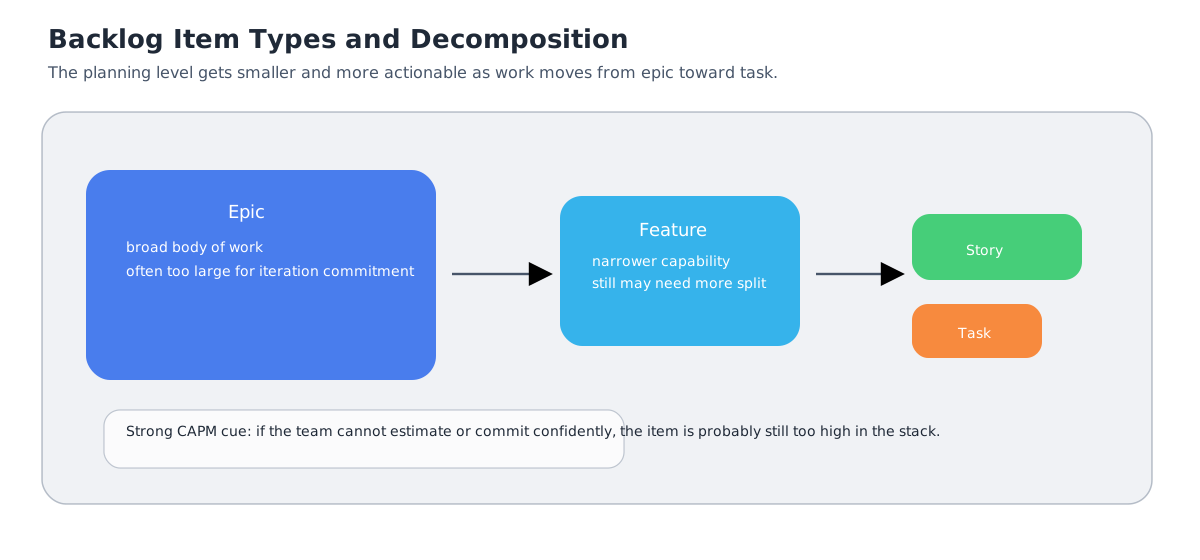
The key thing to notice is that the planning unit should get smaller and clearer as the team moves closer to commitment.
When An Item Is Still Too Big
An item is usually still too large when:
- the team cannot estimate it confidently
- multiple distinct outcomes are hiding inside one label
- different team members describe different work when discussing it
- the item cannot realistically fit inside one short iteration
- acceptance would still be ambiguous even if the work started now
Those are strong CAPM signals that more decomposition is needed.
Example
“Improve claims processing” is likely too broad to commit into one short iteration. It may still be an epic or large feature. The stronger move is to decompose it into smaller stories such as intake validation, status visibility, notification updates, or exception handling before the team estimates or prioritizes it as iteration-ready work.
Exam Scenario
When CAPM gives you a backlog item and asks what to do next, ask:
- Is this item at the right level for the current decision?
- Is it small enough to estimate and commit?
- Does it still combine several different user outcomes?
- Would breaking it down improve value clarity and planning confidence?
That sequence usually reveals the strongest answer.
Common Pitfalls
- treating every backlog label as interchangeable
- forcing rigid local definitions into a general CAPM question
- confusing user-facing value items with technical tasks
- assuming an item is iteration-ready just because it has a verb in its name
- decomposing so far into tasks that the team loses the user-value view
Check Your Understanding
Sample Exam Question
Scenario: A team is discussing a backlog entry called “Improve claims processing.” Nobody can estimate it confidently, different members describe very different pieces of work inside it, and the product owner wants to know whether it is ready for the next iteration.
Question: How should that backlog item be treated?
- A. It is already a task because it has a verb in the title
- B. Item type does not matter because adaptive teams avoid structure
- C. It should be treated as done because the idea exists in the backlog
- D. It is probably still at an epic or broad-feature level and needs more breakdown before iteration commitment
Best answer: D
Explanation: CAPM usually rewards recognizing when work is still too broad to estimate or commit responsibly. That usually means more decomposition is needed.
Why the other options are weaker:
- A: A verb does not make an item iteration-ready.
- C: Visibility alone does not make the item ready.
- B: Adaptive work still uses structured backlog levels for planning.