CAPM User Stories and Acceptance Criteria
Study CAPM User Stories and Acceptance Criteria: key concepts, common traps, and exam decision cues.
User stories give adaptive teams a lightweight way to express need. Acceptance criteria make that need testable. CAPM often tests whether you understand that the story starts the conversation and the criteria make the item usable for delivery.
What User Stories Are Good For
A story usually expresses who needs something, what they need, and why it matters. Its value is not just the sentence template. Its real value is that it keeps the team focused on user need and outcome instead of jumping too quickly into technical implementation detail.
Stories are not automatically complete requirements. They usually need refinement, conversation, and acceptance criteria before the team should treat them as ready work.
What Acceptance Criteria Add
Acceptance criteria define what must be true for one specific item to be considered acceptable. They clarify success conditions, reduce misunderstanding, and support testing, review, and demo readiness.
Without clear criteria, a story may be readable but still ambiguous. The team can build something functional and still miss what stakeholders actually needed.
Story Versus Readiness
CAPM often tests whether a story is merely visible in the backlog or actually ready for delivery. A story is usually not ready just because:
- it follows the “As a… I want… so that…” pattern
- it sounds understandable at a high level
- the team is eager to start
Readiness usually improves when the team has enough shared understanding to estimate, test, and complete the work responsibly.
What Good Acceptance Criteria Usually Do
Strong acceptance criteria usually:
- clarify expected behavior
- make success observable
- reduce ambiguous interpretation
- support testing and review
- help the team say whether the item is truly acceptable
Weak acceptance criteria are usually too vague, too broad, or too dependent on assumptions left unstated.
Visual Guide
This visual shows why the story sentence and the acceptance criteria do different jobs. The story frames user value. The refinement discussion and criteria turn that value statement into something the team can test, review, and treat as ready work.
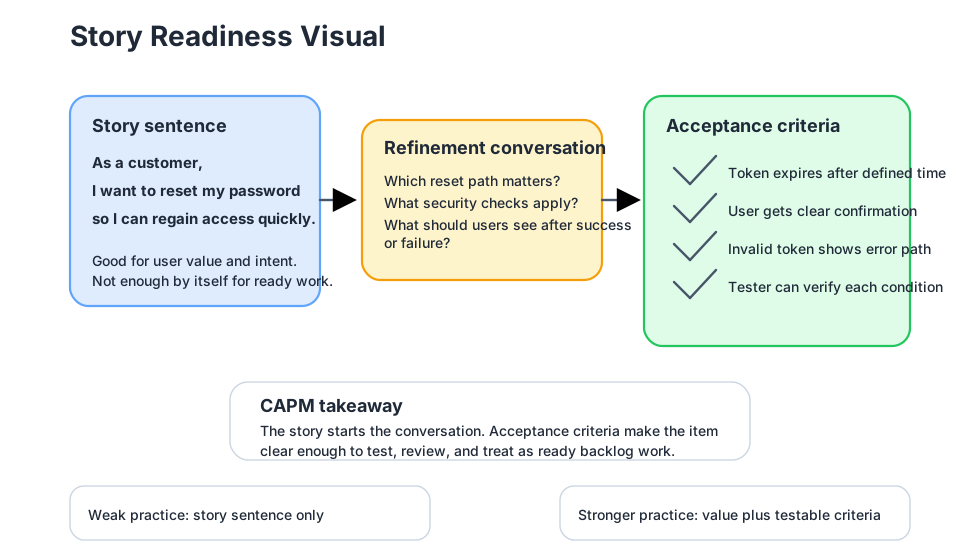
The key thing to notice is that a story by itself frames purpose, but readiness comes from clarification.
A Practical Readiness Pattern
If a team reads a story and still cannot answer what acceptable behavior looks like, the item is probably not ready. That does not mean the story is bad. It means the story still needs refinement.
Typical readiness questions include:
- What counts as success?
- What conditions or variations matter?
- What should happen in error or edge cases?
- How will stakeholders know the item is acceptable?
CAPM often rewards the answer that slows down just enough to clarify those questions before starting work.
Example
A story says, “As a customer, I want to reset my password so I can regain access quickly.” That is a useful start. It still needs acceptance details such as token handling, expiration, invalid-link behavior, and confirmation behavior before the team should treat it as fully ready.
Exam Scenario
When CAPM gives you a story scenario, ask:
- Does the story describe user value clearly enough?
- Are the success conditions explicit?
- Could testers and reviewers tell whether the item is acceptable?
- Is the team about to substitute technical activity for user-value clarity?
These questions usually expose whether the item is genuinely ready.
Common Pitfalls
- treating the story sentence as complete without follow-up clarification
- writing technical tasks and calling them user stories
- skipping acceptance criteria because the story title seems clear enough
- letting one story become so large that it hides several separate needs
- assuming testers should discover the missing criteria later
Check Your Understanding
Sample Exam Question
Scenario: A team writes, “As a customer, I want to manage my account,” and immediately moves the item into delivery without clarifying which account actions matter most, what should happen in common error cases, or how stakeholders will judge success.
Question: What should the team do before starting work?
- A. Assume the sentence alone is enough because stories are meant to stay lightweight and detailed clarification can emerge later in development
- B. Refine the story into clearer needs with acceptance criteria before treating it as ready work
- C. Break the story into technical tasks immediately so the team can begin implementation while business detail is still being discussed
- D. Move the story into the backlog as-is and ask testers to define what account management should mean when they prepare test cases
Best answer: B
Explanation: CAPM usually rewards keeping the value-oriented story while adding the refinement needed to make it understandable, testable, and deliverable.
Why the other options are weaker:
- A: Lightweight format does not remove the need for readiness and clarity.
- C: Jumping to technical tasks too early can disconnect the work from the user outcome.
- D: Passing ambiguity downstream usually spreads the same uncertainty into testing.