CAPM Burndown, Burnup, Velocity, and What the Charts Really Show
Study CAPM Burndown, Burnup, Velocity, and What the Charts Really Show: key concepts, common traps, and exam decision cues.
Burndown, burnup, and velocity are useful adaptive tracking signals, but CAPM usually tests their limits as much as their purpose. The strongest answer reads them as planning and visibility aids, not as magic proof that delivery is healthy.
What Each Signal Shows
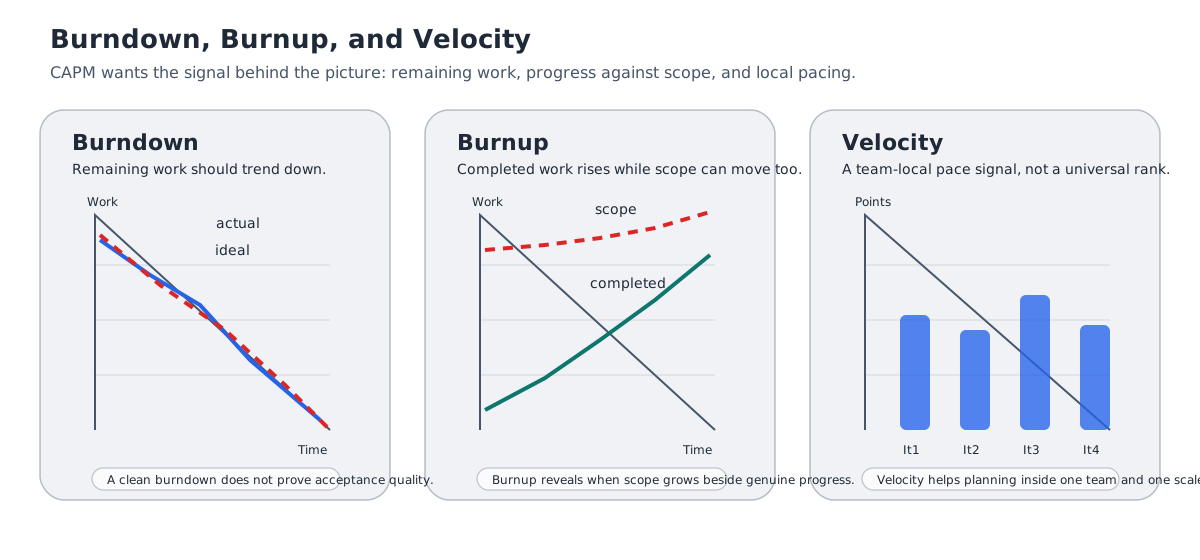
Velocity shows the team’s approximate completed pace across iterations. Burndown shows remaining work over time. Burnup shows completed work rising, often alongside a total-scope line, which makes scope growth easier to see.
Together, these tools help the team ask:
- Are we finishing work at a useful pace?
- Is remaining work decreasing?
- Is scope changing while we deliver?
These are helpful questions, but they are not the only questions. CAPM often tests whether you can tell the difference between delivery visibility and delivery quality. A chart may show progress moving in a reassuring direction while acceptance criteria remain weak, defects reopen work, or scope continues to expand. Strong interpretation requires context.
What The Charts Do Not Prove
Good-looking charts do not guarantee strong acceptance quality. A healthy burndown can still hide items that were marked complete too early. Velocity is also not a fair universal ranking across unrelated teams with different estimation habits and backlogs.
CAPM often rewards balanced interpretation: useful signals, but not perfect truth machines.
That means a good answer usually avoids two extremes:
- overclaiming, such as “the burndown proves the team is healthy”
- dismissing the charts entirely, as if visibility has no value
The stronger position is that these tools are useful when interpreted alongside backlog change, acceptance quality, and team context.
Visual Guide
This side-by-side visual is more useful than a flowchart because the concept lives in the chart shapes themselves. Burndown highlights remaining work dropping over time, burnup makes scope growth visible beside progress, and velocity stays a local pacing pattern rather than a universal performance rank.
When To Use Each Signal
| Signal | Most useful for | Common misread |
|---|---|---|
| Burndown | Seeing whether remaining planned work is dropping | Assuming lower remaining work automatically means high quality |
| Burnup | Seeing progress while also exposing scope growth | Ignoring the total-scope line when scope keeps expanding |
| Velocity | Estimating local delivery pace over multiple iterations | Comparing unrelated teams as if velocity were a universal score |
CAPM often rewards choosing the tool that matches the question. If leadership wants to know whether scope is growing while work is delivered, burnup is often stronger than burndown. If the team wants a rough sense of its own recent pace, velocity is useful. None of them should be treated as complete proof on their own.
What Good Interpretation Looks Like
A balanced interpretation usually checks:
- whether the chart trend is improving or worsening
- whether scope changes explain part of the trend
- whether accepted work is actually meeting quality expectations
- whether the signal is being used locally or misused as a ranking device
This is especially important for velocity. Velocity becomes weak the moment leadership uses it to compare teams with different backlogs, estimation scales, or delivery contexts. CAPM usually treats velocity as a local planning aid, not a portfolio scoreboard.
Example
A release burnup chart shows completed work rising, but the total-scope line is rising almost as fast because new requests keep entering. The stronger reading is not “everything is fine.” It is “progress is real, but growing scope may still delay the target.”
Likewise, a clean-looking burndown may still hide trouble if several stories were marked done before review feedback was complete. The chart can show reduced remaining work even though the team’s quality discipline is weak. The strongest CAPM reading connects the chart to the real completion standard.
Exam Scenario
Leadership sees a strong velocity trend and a steady burndown, then asks whether the release date is now guaranteed. At the same time, the product owner notes that new scope has been entering regularly and some recently completed work may return for rework after review.
The strongest CAPM response is to use the charts as helpful signals, but not as guarantees. Scope growth and weak acceptance quality can change the real forecast even when the charts look healthy.
Common Pitfalls
- treating velocity as a productivity ranking across teams
- assuming a healthy chart automatically means strong acceptance quality
- confusing what burndown and burnup actually measure
- deleting charts instead of learning to interpret them correctly
- reading one chart in isolation when the real issue is scope growth or weak done criteria
- turning velocity into a management comparison metric across different team contexts
Check Your Understanding
Sample Exam Question
Scenario: A team’s burndown chart looks healthy, but several completed items are later reopened because acceptance criteria were not fully met. Leadership also wants to compare the team’s velocity against another team using different estimation habits.
Question: How should leadership interpret those signals?
- A. Velocity and chart visibility are useful signals, but they should be interpreted with quality context and not treated as universal team rankings
- B. The burndown proves delivery quality is strong, and the velocity comparison is fully reliable
- C. The team should stop using all charts because they can be misunderstood
- D. Only burndown matters; acceptance quality can be checked later
Best answer: A
Explanation: CAPM usually rewards using these tools with judgment. Good-looking charts do not override weak acceptance quality, and velocity is not normally a universal comparison metric.
Why the other options are weaker:
- B: It overreads both signals.
- C: The tools are still useful when interpreted properly.
- D: Ignoring quality context is a weak adaptive response.