CAPM WIP Limits, Cumulative Flow, and Bottlenecks
Study CAPM WIP Limits, Cumulative Flow, and Bottlenecks: key concepts, common traps, and exam decision cues.
WIP limits and cumulative flow help the team understand whether work is actually moving or simply piling up. CAPM often tests whether you can recognize that starting more work is not the same as finishing more work.
Why WIP Limits Matter
If too many items are started at once, context switching grows, queues build up, and actual completion slows down. WIP limits help by encouraging the team to finish current work before pulling in more.
This is not about slowing the team arbitrarily. It is about improving focus and making overload visible.
That distinction matters on the exam. A weak answer often assumes that a team facing delay should simply start more work or keep everyone busy. A stronger answer recognizes that overload often creates the delay. When too many items move at once, attention fragments, review queues grow, and blocked work becomes harder to notice. WIP limits are one way to make the system’s real capacity visible.
Why Cumulative Flow Matters
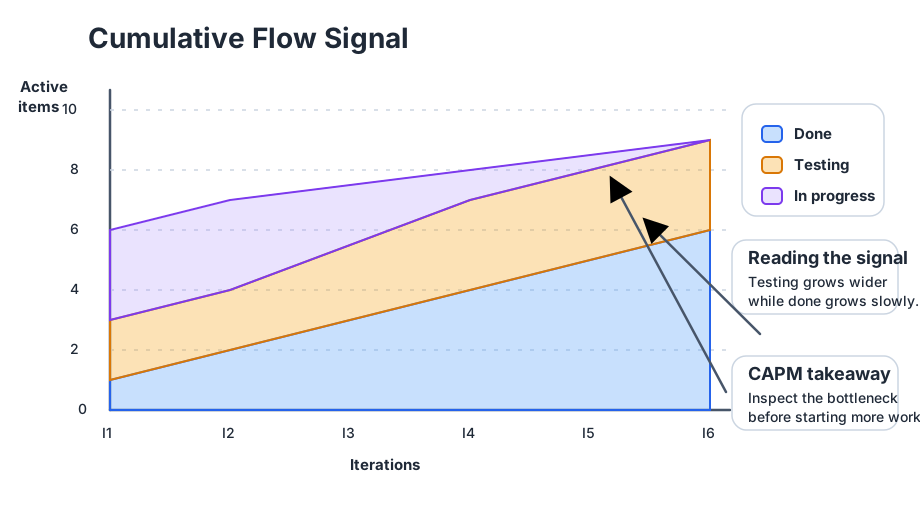
A cumulative flow diagram shows whether work is moving steadily through the workflow or gathering in one stage. Widening bands often suggest queue buildup or a bottleneck. Stable bands suggest more stable flow.
CAPM is usually not asking for deep queueing theory. It is asking whether you can read the signal and decide which part of the workflow needs attention.
The testable idea is simple: if one stage widens while downstream completion grows slowly, work is accumulating there faster than it is leaving. That does not automatically tell you the exact cause, but it does tell you where to inspect. The strongest response is usually to analyze the bottleneck, reduce overload, or rebalance the workflow, not to dismiss the signal.
Visual Guide
The visual below shows the exact flow pattern CAPM usually wants you to notice: the testing band keeps widening while the done band grows more slowly. That combination usually means work is entering testing faster than it is leaving, so the team should inspect that stage and tighten WIP behavior before starting even more work.
What WIP Discipline Actually Changes
WIP limits are useful because they change team behavior:
| Without WIP discipline | With WIP discipline |
|---|---|
| Team members start new work when blocked or waiting | Team members help finish existing work first |
| Review and testing queues quietly expand | The queue limit becomes visible earlier |
| Throughput appears active but completion slows | Flow problems surface sooner |
| Bottlenecks are easier to ignore | Bottlenecks become hard to hide |
CAPM may also test whether you understand that a WIP limit is not the same as inactivity. If a column is full, the stronger response is usually to swarm, unblock, review, or finish existing work. Pulling in additional items often worsens the system.
What Good Flow Control Looks Like
Strong adaptive control in this area usually means:
- start fewer items simultaneously
- finish work before opening more work
- watch for queue buildup between columns
- inspect the stage where work is accumulating
- adjust team behavior instead of blaming the chart
If an answer choice interprets a widening band as “evidence of productivity because lots of work is happening,” it is usually weak. CAPM generally rewards completion-oriented thinking, not activity-oriented thinking.
Example
A team board shows many items in progress but very few reaching done. The testing band on the cumulative flow diagram keeps widening. The stronger interpretation is that a bottleneck or overloaded stage exists and the team should inspect that part of the workflow.
Suppose the team responds by starting even more development work because developers do not want to sit idle while testing is behind. That is usually the wrong move. The stronger move is to help relieve the constrained stage, reduce new inflow, or change the workflow so the queue stops expanding.
Exam Scenario
A team says its backlog is healthy because many stories have been started this iteration. However, the board shows very few stories reaching done, and the cumulative flow view shows work expanding in review and test. One manager proposes adding even more items so everyone stays busy.
The strongest CAPM response is to treat the existing buildup as a flow problem. Adding more simultaneous work usually increases queues and hides the real bottleneck. The team should inspect the constrained stage, enforce WIP discipline, and improve how work moves to done.
Common Pitfalls
- assuming more started work means more productivity
- treating WIP limits as arbitrary slowdown
- ignoring widening workflow bands in cumulative flow
- confusing visible activity with healthy throughput
- using WIP limits as a slogan without changing actual pull behavior
- blaming individual effort when the workflow signal points to system overload
Check Your Understanding
Sample Exam Question
Scenario: A board shows eight items in progress and only one reaching done in several days. The cumulative flow diagram shows the testing band widening over three iterations.
Question: Which interpretation is strongest?
- A. Throughput has improved because a lot of work is active
- B. Testing may be becoming a bottleneck, and the team may need WIP discipline or workflow adjustment
- C. The diagram is irrelevant because only backlog priority matters
- D. The team should start even more work to stay productive
Best answer: B
Explanation: CAPM usually rewards reading widening queues and high simultaneous WIP as signs of overload or bottleneck risk rather than as proof of strong productivity.
Why the other options are weaker:
- A: High activity does not prove completed throughput.
- C: Flow signals and backlog priority answer different questions; both matter.
- D: Starting more work often worsens an existing queue.