CAPM Roadmap Basics
Study CAPM Roadmap Basics: key concepts, common traps, and exam decision cues.
A product roadmap matters because stakeholders often need a view of where the solution is heading without needing every execution detail. CAPM usually tests whether you understand that a roadmap communicates direction and likely progression rather than acting as a locked day-to-day schedule.
What A Roadmap Is Supposed To Communicate
A roadmap usually shows:
- major themes or capability areas
- relative sequencing across time
- the value direction behind the work
- a planning view stakeholders can use for expectation alignment
This makes it broader than a release plan and much broader than a task-level delivery schedule.
CAPM usually treats the roadmap as a communication artifact for direction, not a promise that every detailed step is fixed. A roadmap is strongest when it helps stakeholders understand the intended progression of themes or capabilities and why that progression matters.
Why The Artifact Matters
Without a roadmap, strategic stakeholders may see only fragmented short-term work. With a badly used roadmap, they may see false certainty presented as if every future step were already fixed. CAPM usually rewards the middle position: directional clarity without pretending the future is fully locked.
That middle position is important because roadmap quality depends on two things at once:
- enough clarity to support expectation alignment
- enough flexibility to reflect real learning and change
The weaker answer usually loses one of those two. It either becomes too vague to guide anyone or too rigid to stay credible.
Visual Guide
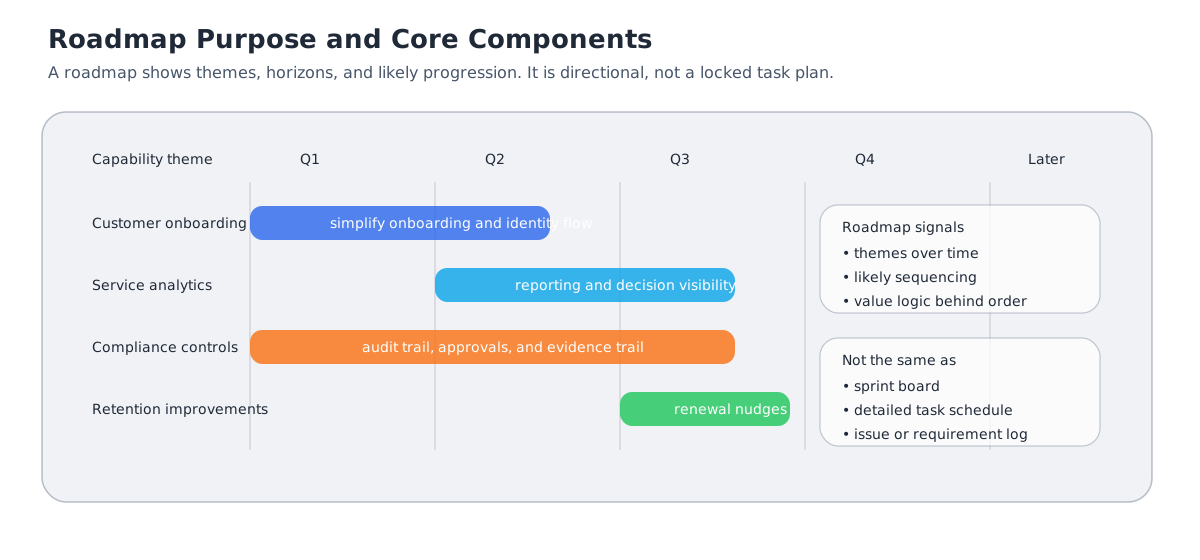
This roadmap layout is more useful than a simple flow because the concept depends on horizon and granularity. CAPM wants you to see a roadmap as a directional time view of themes and progression, not as a day-to-day task schedule or sprint board.
What A Strong Roadmap Adds
| If roadmap thinking is weak | If roadmap thinking is strong |
|---|---|
| Stakeholders see disconnected short-term work only | Stakeholders see how work supports longer direction |
| Future expectations are either absent or unrealistic | Future intent is visible without false precision |
| Themes and goals are not clearly connected | Sequencing is tied back to value direction |
| Reprioritization looks random later | Earlier roadmap logic makes change easier to explain |
CAPM usually rewards the stronger second pattern because it improves communication across strategic horizons.
What CAPM Usually Wants
The exam often asks what a roadmap is mainly for. The strongest answer usually focuses on communication of direction, themes, and likely progression. The weaker answer often mistakes the roadmap for:
- a sprint board
- a task schedule
- a requirements log
Roadmaps are planning communication artifacts. They are not every artifact at once.
Another common trap is to think that uncertainty makes roadmaps useless. CAPM usually favors keeping the directional view while still acknowledging that the later parts of the roadmap are likely to evolve.
Roadmaps And Stakeholder Expectations
A roadmap is often strongest when the team needs to answer questions such as:
- what capability areas are expected to matter over time
- how upcoming work connects to strategy or benefits
- why one major theme is likely to come before another
It is usually weaker when the audience needs exact sprint assignments, task ownership, or current defect detail. CAPM often tests whether you can choose the right level of planning communication.
Example
A steering group wants to understand how customer-service improvements will unfold over the next year and how they support retention goals. A roadmap is the stronger artifact for that question because the group needs direction, themes, and sequencing logic rather than a detailed execution board.
If the team shows only a sprint board, the stakeholders may see activity without understanding the longer-value story. If the team shows a roadmap as if every future month is fixed, they may overstate certainty. CAPM usually favors the more balanced use of the artifact.
Exam Scenario
Leadership asks how service improvements are expected to progress across the next few quarters and how those improvements support customer retention. The delivery team responds by showing only a short-horizon board of near-term work items.
The strongest CAPM response is to introduce a roadmap view that communicates themes, progression, and value direction at the right horizon.
Common Pitfalls
- treating the roadmap as a fixed detailed schedule
- listing isolated features without explaining the broader direction they support
- making the roadmap so abstract that it cannot guide expectations at all
- acting as if roadmaps should never change once shared
- confusing directional planning with exact delivery commitment
- showing near-term execution detail when the real need is broader capability progression
Check Your Understanding
Sample Exam Question
Scenario: A sponsor wants to understand how the next year of service improvements supports retention and compliance objectives. The team currently has only a short-horizon sprint board.
Question: What should the team show that sponsor?
- A. Show the sprint board only because detailed execution artifacts are always enough
- B. Replace the planning discussion with a defect log
- C. Refuse to provide any forward view because future work may still change
- D. Create or use a roadmap that communicates major themes, likely progression, and the value logic behind the sequence
Best answer: D
Explanation: The stronger response gives the sponsor a directional planning artifact that fits the question being asked.
Why the other options are weaker:
- A: Sprint boards are usually too detailed and too short-horizon for strategic direction questions.
- C: Possible change does not remove the need for directional communication.
- B: Operational defect tracking does not explain planned value progression.