CAPM Roadmap Versus Release Plan Versus Backlog
Study CAPM Roadmap Versus Release Plan Versus Backlog: key concepts, common traps, and exam decision cues.
Roadmaps, release plans, and backlogs matter because stakeholders ask different planning questions at different levels. CAPM often tests whether you can choose the artifact that fits the question instead of treating every planning view as interchangeable.
Three Different Planning Horizons
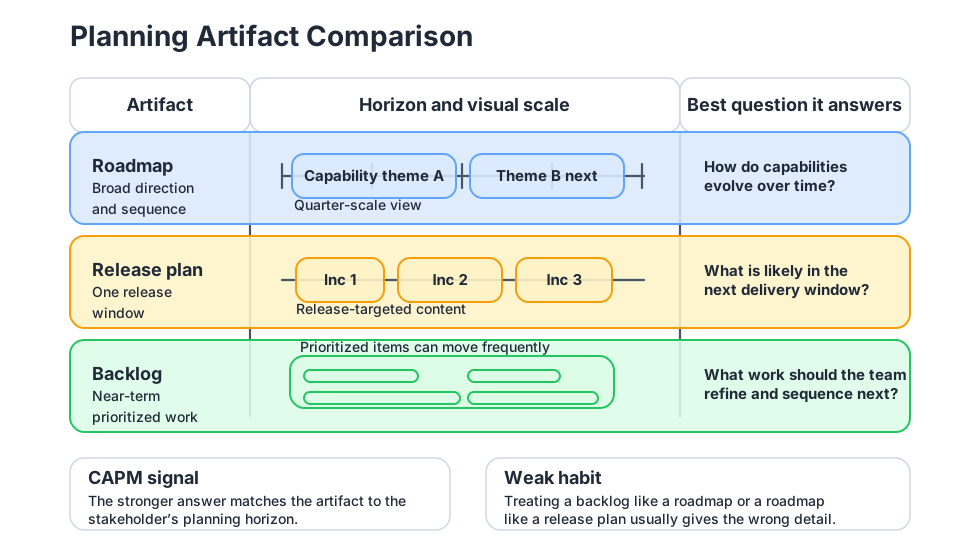
A roadmap shows broad direction and likely sequencing across a wider horizon. A release plan shows what is targeted in a specific release window. A backlog is a living prioritized work list that helps the team refine and sequence upcoming work continuously.
These artifacts are related, but they are not the same thing.
CAPM often tests this with simple but deceptive scenarios. A sponsor may ask a strategic question but receive a backlog dump. A delivery team may ask what is in the next release but receive a high-level roadmap. The strongest answer usually fixes the mismatch between question horizon and artifact horizon.
How The Planning Levels Connect
- roadmap: strategic direction and broader timing horizon
- release plan: what is expected in a particular release window
- backlog: evolving near-term work items and priorities
When CAPM asks what a stakeholder needs to see, the strongest answer usually matches the artifact to that decision horizon.
This is why the artifacts should not be collapsed into one label. A backlog is not just a small roadmap. A roadmap is not just a more decorative backlog. A release plan sits between them, focusing on one delivery window and the content expected there.
Visual Guide
The visual below makes the comparison more concrete than a flowchart. The real distinction is horizon and granularity: a roadmap spans broader direction, a release plan narrows the view to one delivery window, and a backlog stays close to near-term prioritized work that can move frequently.
Matching The Artifact To The Question
| If the stakeholder asks… | Stronger artifact |
|---|---|
| “Where is this solution heading over the next few quarters?” | Roadmap |
| “What is expected in the next release?” | Release plan |
| “What should be refined, split, or reordered now?” | Backlog |
CAPM usually rewards the analyst who matches the planning artifact to the planning question rather than automatically showing the most available document.
What CAPM Usually Wants
If a sponsor wants to know the broad capability path across several quarters, the roadmap is usually strongest. If a release owner wants to know what the next release is expected to contain, a release plan is stronger. If the team needs to reorder and refine work continuously, the backlog is strongest.
The weaker answer often uses one artifact for every planning question and creates either too much or too little detail for the audience.
Another weak answer is to assume that because these artifacts are related, one of them can safely replace the others. CAPM usually treats them as complementary planning views at different levels of granularity and stability.
Why The Distinction Matters
When teams use the wrong artifact:
- strategic stakeholders can get lost in near-term detail
- delivery teams can get only broad direction when they need release specifics
- backlog discussions can be weakened by mixing them with broad long-range communication
The stronger CAPM response preserves the distinction so each audience gets the right level of detail.
Example
A sponsor asks about upcoming service capabilities over the next three quarters. The roadmap fits. The delivery team then asks what is actually targeted for the next release window. The release plan fits. The product owner later reorders the next few candidate items after stakeholder feedback. The backlog fits.
If the analyst hands the same artifact to all three audiences, at least two of them will usually receive the wrong level of planning detail. CAPM often wants you to spot that problem quickly.
Exam Scenario
An executive sponsor wants to understand the next few quarters of capability direction. The release manager wants to confirm what is targeted in the next deployment window. The product owner is trying to reorder near-term items after new feedback.
The strongest CAPM response is not one universal artifact. It is the right artifact for each question: roadmap, release plan, and backlog respectively.
Common Pitfalls
- calling every forward-looking artifact a roadmap
- using a roadmap when the audience really needs release-level specificity
- using a backlog as if it were a strategic communication view
- forgetting that different audiences need different planning granularity
- assuming more detail is always better regardless of audience
- mistaking a release plan for the whole long-range strategy
Check Your Understanding
Sample Exam Question
Scenario: A sponsor asks how capabilities are expected to evolve across the next few quarters, but the BA provides a backlog export full of candidate items and short-term reordering notes.
Question: What should the BA provide instead?
- A. Provide a roadmap view that shows expected capability progression across the next few quarters, and use release-plan or backlog detail only if the sponsor later asks for nearer-term execution specifics
- B. Keep the backlog export, but highlight the ten most important items so it reads more strategically
- C. Remove all forward-looking information because uncertain priorities make directional planning misleading
- D. Replace the backlog export with a traceability matrix so the sponsor can see requirement coverage
Best answer: A
Explanation: The stronger response matches the planning artifact to the stakeholder’s horizon. A roadmap is built for directional, multi-quarter capability communication, while release plans and backlogs serve nearer-term planning.
Why the other options are weaker:
- B: A backlog remains too item-level and fluid even if a few entries are highlighted.
- C: Uncertainty does not remove the need for directional planning.
- D: Traceability supports change impact and coverage, not strategic sequencing.