CAPM Compression and Schedule Tradeoffs
Study CAPM Compression and Schedule Tradeoffs: key concepts, common traps, and exam decision cues.
Schedule compression is the attempt to shorten the approved schedule without cutting approved scope. CAPM usually tests this by asking whether the project manager chooses the right recovery method for the actual constraint. The exam is not rewarding impatience. It is rewarding disciplined schedule judgment.
Compression Is Not The First Response
Before compressing anything, the project manager should understand what is actually causing schedule pressure:
- Is a critical-path activity slipping?
- Is the problem poor sequencing rather than duration?
- Is the estimate unrealistic?
- Is the delay on a noncritical path with remaining float?
If the team skips those questions, it may spend money or create overlap on work that does not improve the finish date. CAPM often treats that as a weak control response.
The Two Main Techniques
The exam usually focuses on two compression methods:
| Technique | What changes | Strongest use case | Main tradeoff |
|---|---|---|---|
| Crashing | Adds resources, cost, or capacity to shorten duration | The task is on the critical path and can truly be accelerated with more capacity | Higher cost, coordination overhead, or resource-management complexity |
| Fast tracking | Overlaps activities that were originally sequential | Downstream work can begin with sufficiently stable upstream inputs | Higher rework risk, coordination risk, and quality exposure |
The strongest answer usually matches the technique to the constraint. Crashing changes capacity. Fast tracking changes sequence logic.
When Crashing Is Stronger
Crashing is stronger when all of the following are mostly true:
- the work is on the critical path or very near it
- added resources can actually shorten the activity
- the added cost is acceptable relative to the recovery gained
- the activity is not so specialized that adding people slows it down
Examples include adding a second installation team, paying for expedited vendor support, or increasing staffing on a task that can be parallelized safely.
Crashing is weaker when the task cannot be split effectively, when onboarding new resources would consume the time being saved, or when the recovery is too small to justify the extra cost.
When Fast Tracking Is Stronger
Fast tracking is stronger when:
- a downstream activity can begin with partial but stable upstream inputs
- the team understands what can overlap and what still cannot
- the increased coordination risk is acceptable
- quality can still be protected
Examples include drafting training materials while final configuration is underway, or preparing test scripts while the build is nearing completion, but only if the upstream work is stable enough that rework is unlikely.
Fast tracking becomes weak very quickly when the overlap depends on uncertain approvals, shifting requirements, unstable designs, or incomplete configuration. In that situation, the schedule may look faster while the project quietly imports defect risk and later rework.
Compression Still Depends On Critical Path Logic
A common CAPM trap is to compress an activity that is not driving project completion. If a task has float, shortening it may improve local efficiency without moving the finish date at all. The project manager should first confirm whether the targeted work is actually on or near the critical path.
This is why schedule compression questions are usually connected to the earlier scheduling lessons:
- validate the dependency logic
- identify the critical path
- confirm where the real time pressure sits
- choose the least damaging recovery option
Compression Affects More Than Time
CAPM also expects you to read compression as a broader control decision. Even when scope stays fixed, schedule recovery can affect:
- cost baseline or funding needs
- quality-control activities and defect exposure
- risk responses and contingency thinking
- vendor commitments and procurement timing
- stakeholder expectations about readiness
- integration across scope, schedule, and cost baselines
That means the project manager should not treat compression as only a scheduling trick. If the recovery approach materially changes cost, quality, or risk, the change may require sponsor awareness or formal review under the project’s control process.
Visual Comparison
This comparison matters because the two techniques spend different things. Crashing usually spends more cost or capacity on the same sequence. Fast tracking usually spends more certainty by overlapping work that used to wait.
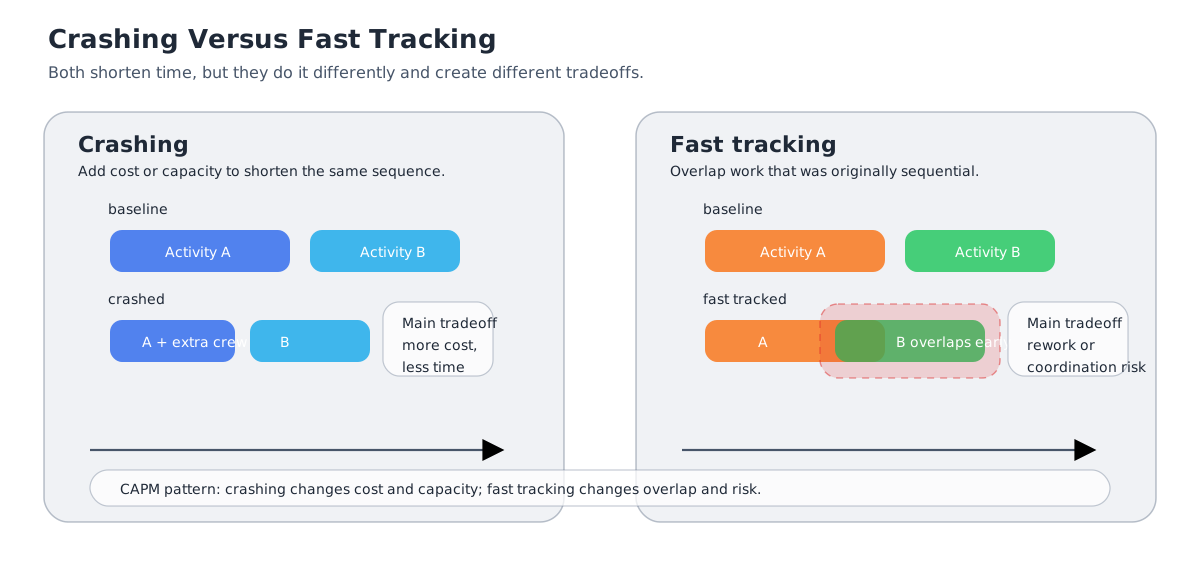
Neither technique is free. One usually buys time with money. The other often buys time with higher coordination and rework exposure.
Worked Example
Assume a project needs to recover two weeks on a critical-path deployment activity.
- If a second qualified crew can work in parallel at acceptable cost, crashing may be strong.
- If testing is proposed to overlap with still-changing configuration, fast tracking is weak because the inputs are unstable.
- If documentation can begin from a mostly stable design while final refinements continue, fast tracking may be reasonable because the overlap is controlled and the likely rework is limited.
The exam distinction is not “which option is faster in theory?” It is “which option improves the finish date with the least damaging side effect under these conditions?”
How To Read Compression Questions
When CAPM presents schedule recovery pressure, use this decision order:
- Is the threatened activity on the critical path?
- Can the task be shortened by added capacity, or is the constraint logical rather than resource-based?
- If overlap is proposed, are the upstream inputs stable enough?
- What new cost, quality, coordination, or governance burden does the option create?
- Does the project manager need approval before applying the recovery move?
This sequence keeps you from choosing the option that sounds aggressive but creates a weaker overall project outcome.
Common Pitfalls
- compressing noncritical work and expecting the finish date to improve
- calling every acceleration tactic crashing
- fast tracking work that still depends on unstable inputs
- ignoring quality, risk, or cost side effects
- assuming the project manager can always compress the schedule without governance review
Check Your Understanding
Sample Exam Question
Scenario: A predictive project must recover two weeks. One option is to add a second contractor crew to a critical-path installation activity at additional cost. Another option is to overlap user acceptance testing with configuration work that is still changing and has unresolved defects. The project manager has authority to recommend a recovery option, but any material cost or risk change must still be reviewed through the project’s control process.
Question: Which response is strongest?
- A. Fast track the unstable testing immediately because avoiding extra spend is always preferable to adding resources
- B. Compress both activities at once because all recovery options are equally valuable under schedule pressure
- C. Delay the decision until the finish date slips officially, since compression should not be considered proactively
- D. Crash the critical-path installation activity if the added cost is acceptable, and avoid overlapping unstable testing that is likely to create rework
Best answer: D
Explanation: CAPM usually expects you to distinguish the two techniques and choose the one that fits the actual constraint. Adding capacity to a critical-path activity may recover time while preserving the logic of the work, assuming the added spend is justified and reviewed appropriately. Overlapping unstable testing with changing configuration is a weak fast-tracking choice because the likely speed gain is offset by rework, coordination burden, and quality risk.
Why the other options are weaker:
- A: Fast tracking is not automatically stronger just because it avoids extra direct spend.
- B: Compression choices are not interchangeable; they depend on criticality, stability, cost, and rework exposure.
- C: Strong control interprets schedule pressure early rather than waiting for a worse failure state.