CAPM Critical Path, Float, and Schedule Variance
Study CAPM Critical Path, Float, and Schedule Variance: key concepts, common traps, and exam decision cues.
Critical path and float help the project manager decide where schedule pressure really sits. CAPM usually tests whether you can distinguish the finish-date driver from background activity noise, and whether you can combine network logic with baseline-performance signals instead of confusing them.
What Makes A Path Critical
The critical path is the longest-duration path through the current activity network. It controls the earliest possible completion date for the project as the schedule is currently built. If an activity on that path slips and nothing else changes, the project finish is more likely to slip as well.
This is where CAPM sets traps. Critical does not mean:
- highest cost
- biggest stakeholder attention
- highest technical difficulty
- most activities
Critical means the path is currently driving completion.
How CAPM Wants You To Think About Float
Float is the schedule flexibility available before a delay affects a later date or the project finish. CAPM typically uses simple total-float logic rather than advanced scheduling theory, so the practical interpretation matters more than the terminology debate.
- positive float means there is some cushion
- zero float means there is no current cushion
- very low float means the activity may be near-critical even if it is not critical yet
The exam often tests whether you can avoid two wrong extremes:
- “Any delayed activity delays the whole project”
- “If an activity has float, it does not matter”
Neither is true. Float means limited flexibility, not irrelevance.
A Simple Way To Read Criticality
In a simple network, the project manager compares path durations. The longest path is critical. Shorter paths have some cushion. If one of those shorter paths grows because of a delay or a logic change, the critical path can move. CAPM may describe exactly that situation, so do not assume that the path that was critical last month is still critical after replanning.
Critical Path Signals And Responses
| Signal | What it usually means | Strong response |
|---|---|---|
| Delay on the critical path | Finish date is more directly threatened | Investigate immediately and assess recovery options |
| Positive float on a noncritical path | Some delay may be absorbed | Monitor the remaining cushion instead of overreacting |
| Zero float | No buffer exists at that point in the schedule | Treat the work as schedule-sensitive even before a slip occurs |
| Shrinking float | A path may be becoming near-critical | Escalate attention before it becomes a finish-date driver |
| Changed durations or dependencies | The path controlling the finish may have changed | Re-read the network instead of relying on an older calculation |
Using The Network, Not Guesswork
The network below shows why path duration matters more than how busy a path looks. The upper path totals 24 days, so it drives the finish. The lower path is shorter, which means it has float.
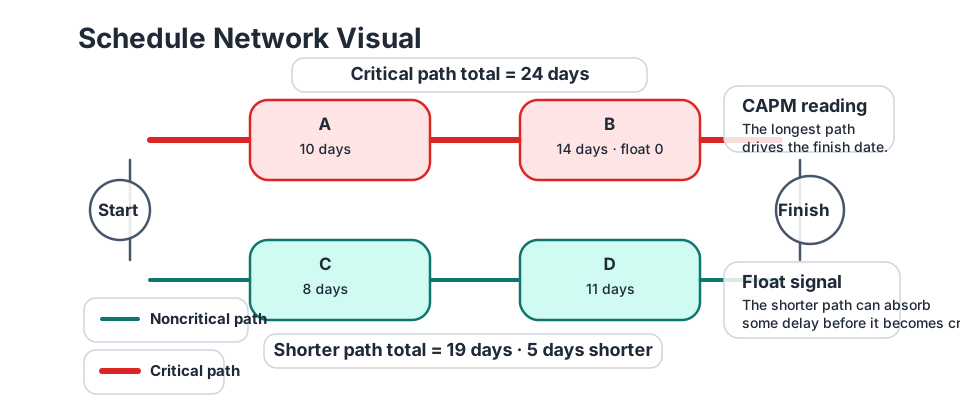
The key CAPM lesson is that schedule-critical work is defined by finish-date impact, not by appearance.
Where Schedule Variance Fits
Schedule variance belongs to earned value analysis. It tells you how actual schedule performance compares with the baseline at a given point in time. It does not replace critical-path analysis.
Formula
$$ SV = EV - PV $$
Where:
- (SV) is schedule variance
- (EV) is earned value
- (PV) is planned value
Interpret it like this:
- positive (SV): more value has been earned than planned by this point
- zero (SV): schedule performance matches the baseline
- negative (SV): less value has been earned than planned by this point
This is a performance signal. It tells you whether the project is ahead of, on, or behind the baseline. It does not tell you which path is critical.
Network Logic And Baseline Signals Are Complementary
CAPM often gives you both kinds of information in one question. The strong interpretation is:
- the network tells you where finish-date pressure sits
- float tells you how much flexibility exists on each path
- schedule variance tells you whether the project is ahead of or behind the baseline overall
These answers can point in the same direction, but they are not interchangeable. A project can have a negative (SV) and still need the network analysis to identify which activity deserves the most urgent action. Likewise, a project can have a critical path even when earned value data is not provided.
Reading Gantt Baseline Versus Actual Views
When CAPM gives you a bar chart or schedule snapshot, look for the following:
- milestone dates that shifted from the baseline
- late starts or finishes on critical or near-critical activities
- noncritical tasks using up float faster than expected
- progress that looks acceptable on individual tasks but still threatens the critical path
A common exam trap is a task that looks only slightly late in isolation but sits on a zero-float path. In that case, the small slip matters more than a larger slip on a path with cushion.
Worked Example
Assume a project has two major paths:
- Path A: 18 days
- Path B: 22 days
Path B is critical because it is longer. If an activity on Path B slips by one day and no corrective action is taken, the project finish may also slip by one day. If an activity on Path A has three days of float, a one-day delay may not yet affect the finish date, although the remaining cushion drops from three days to two.
Now add earned value data:
$$ SV = EV - PV = 90 - 100 = -10 $$
The project is behind planned schedule performance overall. That tells you the baseline is not being met. The network then helps you identify where that slippage is most dangerous to the finish date.
How To Answer Critical Path Questions
When CAPM presents a schedule exhibit, work through this order:
- Which path currently has the longest duration?
- Which activities have zero or very little float?
- Has any delay consumed float on a formerly noncritical path?
- What does schedule variance say about performance against the baseline?
- Do the network signal and the baseline signal point to the same priority?
This process keeps you from confusing a reporting metric with the schedule logic itself.
Common Pitfalls
- choosing the path with the most tasks instead of the longest duration
- treating float as free time to spend casually
- assuming zero float means the project has already failed
- using schedule variance as though it identifies the critical path
- forgetting that the critical path can shift when durations or dependencies change
Check Your Understanding
Sample Exam Question
Scenario: A predictive project has two main paths. Path A totals 19 days. Path B totals 24 days and contains an activity with zero float that is forecast to slip by one day. The current status report also shows (EV = 92) and (PV = 100).
Question: What is the strongest interpretation?
- A. The shorter path is critical because shorter paths usually have less flexibility, and the project is over budget
- B. The 24-day path is critical, and the project is behind planned schedule performance because (SV) is negative
- C. The one-day slip is unlikely to matter because schedule variance already captures all path-level risk
- D. Zero float means the activity is complete and no further schedule interpretation is needed
Best answer: B
Explanation: CAPM usually rewards recognizing both signals correctly. The longest path drives project duration, so the 24-day path is critical. Because (SV = EV - PV = 92 - 100 = -8), the project is also behind planned schedule performance. The negative variance reinforces schedule concern, but the network still identifies where the finish-date driver sits.
Why the other options are weaker:
- A: The shorter path is not critical just because it is shorter, and schedule variance does not prove a cost overrun.
- C: Schedule variance does not replace network analysis; it complements it.
- D: Zero float means no cushion, not completion.