PMI-ACP Planning, Flow, and Work in Progress
Study PMI-ACP Planning, Flow, and Work in Progress: key concepts, common traps, and exam decision cues.
Flow on PMI-ACP is a system property, not a team-motivation slogan. The exam expects you to recognize when delivery is slowing because too much work has been started, handoffs are accumulating, or commitments ignore actual capacity.
The strongest answers usually improve end-to-end movement of value. Weak answers try to solve flow problems by starting more work, pushing people harder, or protecting local utilization even while the system gets slower.
Planning Should Support Focus, Not Activity
Agile planning is strongest when it creates a believable near-term commitment and leaves room for learning. That usually means the team chooses a small enough set of work to finish, not a large set of work to look ambitious. PMI-ACP often rewards answers that reduce queue growth and increase completion quality rather than answers that maximize apparent busyness.
When a scenario mentions partially done work everywhere, frequent handoffs, or many blocked items, the real problem is often planning beyond practical capacity. The stronger response is usually to narrow focus, clarify pull order, and finish before starting more.
Flow symptom table
| Symptom | Stronger agile interpretation | Better next move |
|---|---|---|
| many items started, few finishing | WIP is too high and the system is overloaded | reduce WIP and focus completion |
| one stage keeps filling up | a bottleneck or queue constraint exists | expose the constraint and rebalance around it |
| people are fully busy but throughput is flat | utilization is being mistaken for flow | optimize end-to-end movement, not local activity |
| work waits between handoffs | batching or coordination is slowing delivery | shrink batch size or improve pull and visibility |
Visual Guide
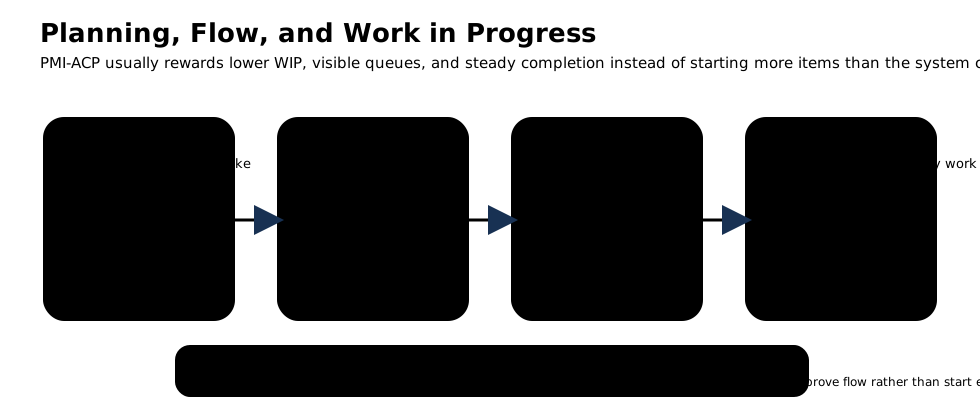
The stronger PMI-ACP answer usually improves the system shown here: fewer simultaneous items, more visible bottlenecks, shorter waits, and a steadier stream of finished value.
WIP Limits Protect Flow
Work-in-progress limits are not there to make the board look tidy. They are a control mechanism. By limiting how much can be active at once, the team exposes bottlenecks earlier, reduces context switching, and makes blocked work harder to ignore. PMI-ACP usually treats high WIP as a warning sign that the team is carrying hidden delay and coordination cost.
That is why “everyone is busy” is not proof that delivery is healthy. If cycle time grows while completion stays flat, the stronger interpretation is usually overload, not productivity.
Optimize The Constraint, Not The Loudest Person
Flow problems often show up in one stage first: testing, review, integration, approval, or customer clarification. A weak response is to pressure the entire team equally or push more work into the same constrained area. A stronger response is to expose the bottleneck, reduce upstream WIP, and rebalance help around the actual constraint.
PMI-ACP questions often hide this pattern inside ordinary language. If one step keeps filling while another waits, the exam is usually asking whether you can see the system problem instead of blaming individual effort.
Interruptions And Expedites Need Explicit Rules
Many delivery systems become unstable because urgent work arrives informally. Teams then say yes to everything, break focus, and lose predictability. Stronger agile practice uses explicit policies for interruptions: who can expedite, what work can be paused, and how the team keeps the normal flow visible while handling truly urgent items.
The exam usually rewards protecting flow first. Expedite work may be necessary, but it should be visible, exceptional, and controlled.
Stronger answers usually do
- limit work in progress when overloaded systems create delay
- plan in a way that supports focus and achievable commitments
- look for bottlenecks and queue buildup instead of blaming individuals first
- optimize end-to-end movement of value instead of local busyness
Common traps
- starting more work to feel productive while throughput worsens
- equating full utilization with healthy flow
- making commitments without regard to system capacity
- ignoring handoff or waiting time because people appear occupied
Exam Scenario
An agile team has strong technical skills, but stakeholders complain that delivery is unpredictable. The board shows many items in review and testing, while developers continue starting new work to stay busy. A manager proposes raising utilization targets so no one has idle time.
The stronger PMI-ACP response is to reduce WIP, make the bottleneck visible, and shift attention toward finishing flow instead of local busyness. The weak response is to optimize activity while the system queue keeps growing.
Check Your Understanding
Sample Exam Question
Scenario: A team uses a visual board with columns for analysis, development, review, and testing. For three iterations, most items have piled up in review and testing while developers keep pulling new items so they remain fully utilized. Completion rate has not improved.
Question: What is the strongest PMI-ACP response?
- A. Ask developers to start additional items so no one waits on review capacity
- B. Increase schedule pressure and require daily completion quotas
- C. Reduce WIP, expose the review and testing bottleneck, and help the team finish current work before starting more
- D. Remove the board because the visible queue is lowering morale
Best answer: C
Explanation: PMI-ACP usually rewards improving end-to-end flow, not local utilization. When one stage is constrained, the stronger response is to limit inflow, expose the bottleneck, and shift effort toward finishing work.
Why the other options are weaker:
- A: Starting more work usually increases queue pressure and context switching.
- B: Pressure does not remove a structural bottleneck.
- D: Hiding the problem weakens visibility instead of improving flow.