PMI-ACP Quality, Feedback, and Customer Collaboration
Study PMI-ACP Quality, Feedback, and Customer Collaboration: key concepts, common traps, and exam decision cues.
Quality and customer collaboration belong inside delivery, not after delivery. PMI-ACP usually rewards answers that build quality into the workflow and use real feedback early enough to change direction while change is still affordable.
Strong answers make verification and value feedback continuous. Weak answers postpone both until the team has already invested too much in the wrong thing.
Built-In Quality Protects Agile Speed
One of the most common exam traps is confusing speed with agility. PMI-ACP does not reward shipping quickly if the work is unstable, unverified, or not actually useful. Quality practices such as clear acceptance expectations, frequent testing, and a meaningful definition of done are there to keep fast delivery from becoming fast rework.
That is why “done” must mean more than development finished. If testing, integration, documentation, customer validation, or other required quality conditions are missing, the work is not truly complete.
Quality-and-feedback table
| Practice | Stronger agile use | Weak use |
|---|---|---|
| definition of done | clarify quality conditions before completion is claimed | treat done as “coding finished” only |
| testing and verification | expose quality problems while change is still cheap | delay testing until the end |
| customer or product feedback | steer value direction during delivery | collect comments after release only |
| collaboration with stakeholders | improve shared understanding continuously | assume internal team agreement is enough |
Visual Guide
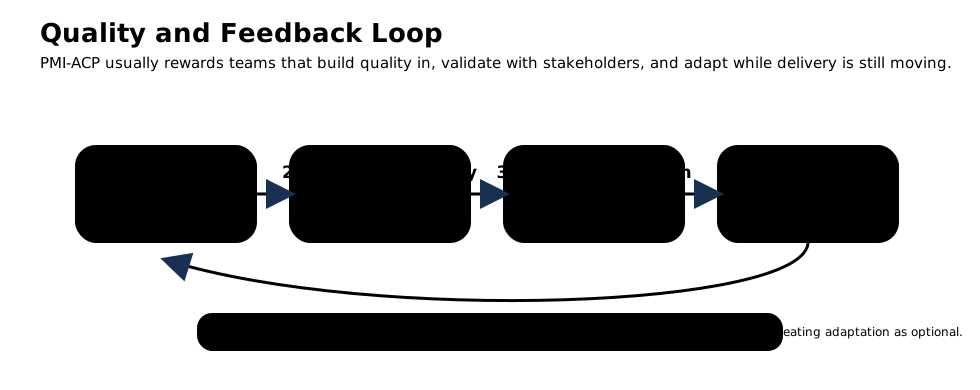
The stronger PMI-ACP pattern is continuous: quality checks and customer feedback happen during delivery, not after delivery is treated as final.
Different Feedback Answers Different Questions
PMI-ACP often distinguishes between two kinds of useful feedback:
- implementation feedback, which checks whether the solution works correctly
- value feedback, which checks whether the right solution is being built
Both matter. A team can deliver something technically correct that solves the wrong problem. It can also deliver something desirable that fails basic quality expectations. The strongest answers keep both loops active.
Customer Collaboration Needs Active Design
The exam usually rewards deliberate customer engagement. That might mean reviews, demos, usability observation, direct stakeholder discussion, or Product Owner-mediated feedback. The exact method depends on the context, but the principle is stable: the team should get useful external information soon enough to act on it.
If stakeholder feedback conflicts, the stronger response is usually to clarify the product goal, compare the feedback against value and outcomes, and decide transparently. It is usually weaker to accept every request equally or to ignore external feedback because internal consensus feels easier.
What stronger answers usually do
- use definition of done, testing, and frequent verification to keep quality visible
- involve customers or product stakeholders in ways that improve learning
- treat feedback as a steering mechanism for value delivery
- correct quality or expectation issues early rather than accepting rework later
Common traps
- treating testing as a final phase
- assuming internal agreement is enough without customer validation
- shipping low-quality work quickly and calling it agility
- collecting feedback too late to respond efficiently
Exam Scenario
An agile team is delivering features on schedule, but customers say the product still does not solve the real need. Internal testing is strong, and the team points to its high completion rate as proof that delivery is healthy.
The stronger PMI-ACP response is to strengthen the value-feedback loop with real stakeholder engagement while preserving built-in quality. The weak response is to assume that internal quality alone proves customer value.
Check Your Understanding
Sample Exam Question
Scenario: A team delivers increments frequently and passes its internal testing. During a customer review, several users say the newest feature works as designed but does not solve their most important problem. Team members argue that quality is high because the increment passed all technical checks.
Question: What is the strongest PMI-ACP response?
- A. Keep the current approach because technical quality proves the team is delivering value
- B. Delay further customer sessions until the release is larger and more polished
- C. Add more internal test scripts and reduce stakeholder participation to avoid confusion
- D. Preserve built-in quality practices but strengthen value-focused customer feedback so the team can adapt product direction earlier
Best answer: D
Explanation: PMI-ACP usually distinguishes technical correctness from product value. Strong agile delivery needs both built-in quality and meaningful customer feedback to confirm that the team is solving the right problem.
Why the other options are weaker:
- A: Technical quality alone does not confirm customer value.
- B: Delaying feedback increases the cost of changing direction.
- C: More internal testing does not replace real external validation.