PMI-SP Cheat Sheet
High-yield PMI-SP review for key rules, traps, decision cues, formulas, and final-week reminders.
Use this as your last-mile PMI-SP® review. Pair it with the Syllabus for the official domain map and Practice for speed.
For exam-policy details, use Overview.
Visual Guide
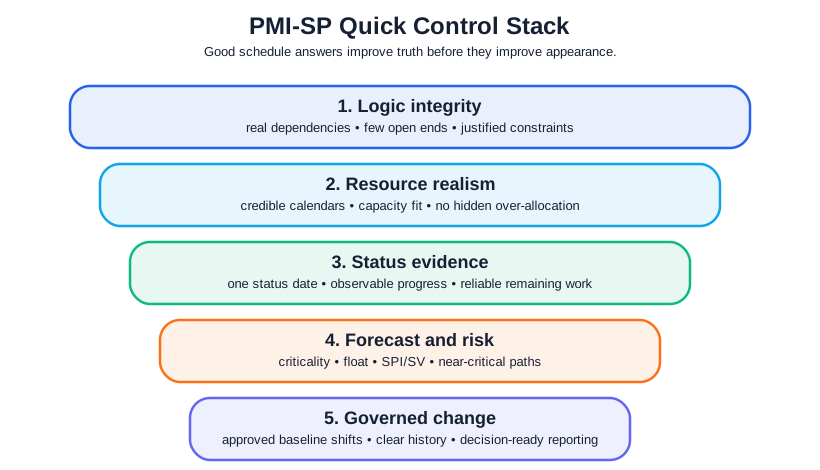
A strong PMI-SP answer makes the schedule more decision-worthy, not just more polished. The usual exam flow is: logic integrity first, then resource realism, then credible status data, then forecasting, then governed change.
Domain emphasis snapshot
| Domain | Weight | What to lock in |
|---|---|---|
| Schedule Strategy | 14% | governance, scope of the schedule system, decision thresholds |
| Schedule Planning and Development | 31% | sequencing, calendars, durations, resources, baseline development |
| Schedule Monitoring and Controlling | 35% | status quality, float/criticality, forecasting, corrective action |
| Schedule Closeout | 6% | archive quality, lessons learned, final records |
| Stakeholder Communications Management | 14% | presenting schedule truth clearly enough to drive action |
Logic integrity first
| Item | What good looks like | Weak-answer pattern |
|---|---|---|
| dependency logic | real FS, SS, FF, or SF relationships based on work reality | using arbitrary dates instead of logic |
| leads and lags | justified by actual handoff or waiting time | hiding bad logic with cosmetic lags |
| constraints | used only when externally required | date-constraining activities because planning is weak |
| open ends | almost none in an integrated network | activities with no predecessor or successor for no real reason |
| near-critical paths | monitored like critical when exposure is high | tracking only one path and ignoring thin float elsewhere |
Relationship quick table
| Type | Meaning | Fast cue |
|---|---|---|
| FS | successor starts after predecessor finishes | most common handoff |
| SS | successor starts after predecessor starts | overlap begins together |
| FF | successor finishes after predecessor finishes | finish alignment matters |
| SF | successor finishes after predecessor starts | rare but still testable |
Critical path and float formulas
Critical path is the longest path through the network and therefore drives the earliest finish date.
Total float is the amount an activity can slip before it pushes the project finish or a constrained milestone.
[ \text{TF} = LS - ES = LF - EF ]
When a path has very low float, treat it as near-critical even if it is not technically the current critical path.
Resource realism and schedule credibility
| Topic | What good schedulers do | What weak schedulers do |
|---|---|---|
| calendars | model real crews, shifts, and non-working time | assume ideal availability |
| resource limits | re-check sequence and duration after leveling or smoothing | keep the same critical path story after the model changed |
| long-duration activities | challenge them and decompose when needed | leave them vague and hide risk inside them |
| subcontractor data | align external schedules to the integrated master schedule | let supplier schedules drift separately |
Status data rules
| If the problem is… | Better rule | Why it matters |
|---|---|---|
| inconsistent cut-off dates | use one status date across the model | keeps analysis comparable |
| subjective percent complete | tie progress to observable outputs or rules of credit | reduces “almost done” bias |
| out-of-sequence work | update actuals and fix logic explicitly | hidden breaks create false forecasts |
| stale remaining duration | challenge what is still left, not just what was planned | forecast quality depends on remaining work realism |
| narrative-only status | connect claims to deliverables, quantities, or milestones | schedule truth needs evidence |
Baseline, forecast, and re-baseline
| Artifact | Use it for | Wrong use |
|---|---|---|
| baseline | measurement reference | rewriting history to hide slippage |
| current forecast | best current completion outlook | pretending it is still the baseline |
| approved re-baseline | reflect authorized scope or strategy change | cleaning up avoidable execution variance |
Schedule QA scan
| Check | Why it matters | Common next action |
|---|---|---|
| open ends | broken logic distorts float and path analysis | add the missing real predecessor or successor |
| excessive constraints | dates look clean but logic truth is hidden | replace with logic where possible |
| unjustified lags | hides risk and makes recovery harder to see | convert to explicit work or valid waiting conditions |
| negative float | signals impossible dates or broken assumptions | escalate and analyze cause, not just “work harder” |
| unrealistic calendars | false optimism contaminates all forecasts | align shifts, holidays, access windows, and crews |
EVM schedule signals
[ SV = EV - PV ]
[ SPI = \frac{EV}{PV} ]
| Signal | Interpretation | Better follow-up |
|---|---|---|
| (SV < 0) | earned progress is behind the plan | inspect critical and near-critical drivers, not only totals |
| (SPI < 1) | schedule efficiency is weak | check logic, resources, and status quality before promising recovery |
| good SPI but unstable logic | metric is not enough | fix the schedule model before trusting the forecast |
Fast elimination rules
- If a choice makes the schedule look cleaner without improving logic or evidence, it is usually wrong.
- If a change affects baseline logic, dates, or scope, govern it instead of quietly editing the file.
- If the model is already weak, more reporting will not help until the schedule logic and status data are credible.